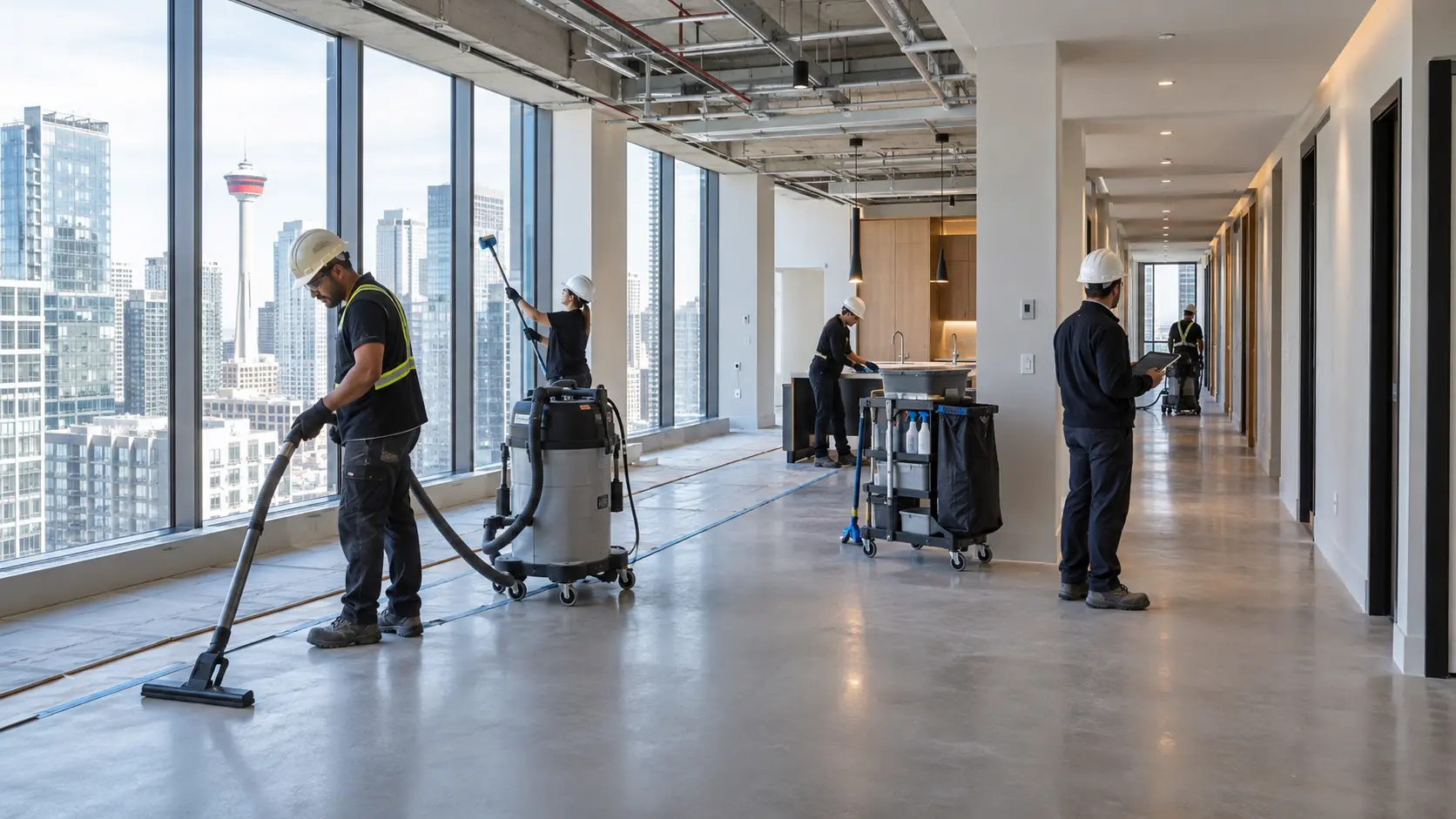
Who is responsible for final cleaning on a Calgary commercial construction project?
Responsibility for final cleaning on a Calgary commercial construction project depends on the written contract, trade scopes and closeout assignments. It may sit with the general contractor, individual subcontractors, the owner, the tenant or a separately hired cleaning provider. Eshine Cleaning Services coordinates its work with the authorized party responsible for the final-cleaning scope.
The direct answer: responsibility depends on the contract and assigned scope
No single party is automatically responsible for every stage of construction cleaning. The prime contract establishes obligations between the owner and contractor, while subcontract agreements assign trade-specific cleanup. An approved cleaning proposal defines the cleaner’s tasks, but it does not independently assign responsibility for the entire project.
The closeout plan should connect these documents through a written schedule, responsibility matrix or turnover checklist. It should identify who coordinates trade cleanup, general site cleanup, professional final cleaning, cleaning after construction deficiencies and pre-occupancy touch-ups.
If the project documents leave an area or task unassigned, the project team must resolve that gap before cleaners are booked. The cleaning provider should not be expected to determine contractual responsibility on behalf of the owner, contractor or trades. This article explains operational coordination and does not interpret any specific construction contract.
How cleaning responsibility is commonly divided
Construction cleaning usually occurs in several stages. Trade cleanup follows individual work activities. General site cleanup removes materials that prevent detailed service. Professional final cleaning prepares released areas for the agreed turnover inspection.
Cleaning after construction deficiency work addresses contamination created by repairs completed after the final clean. Pre-occupancy touch-ups occur closer to handover and address limited dust, marks or traffic-related soil without repeating the entire final-cleaning scope. Responsibility can change between each stage.
Trade cleanup and removal of work-generated debris
Subcontractors are commonly expected to remove packaging, cut-offs, disposable materials and debris produced by their work when their trade agreement requires it. This prevents other trades or the final-cleaning team from inheriting waste they were not scheduled or equipped to handle.
A trade scope may require an area to be left “broom-clean,” but that term does not have one universal project standard. The agreement should define the required tasks and acceptable condition instead of relying on the label alone.
Trade cleanup does not necessarily include detailed cleaning of completed rooms. Dust, adhesive residue, labels or marks may remain even after a subcontractor removes its tools and debris.
Temporary surface protection, masking materials and trade-installed labels also require written assignment. The responsible trade may remove them, or the final-cleaning provider may do so when the surfaces, removal methods and related risks are included in the approved scope.
Disposal duties must be equally clear. Moving debris to a designated collection point is different from loading bins, arranging hauling or paying disposal charges.
General site cleanup and professional final cleaning
General site cleanup removes loose debris, surplus materials and temporary waste that would prevent detailed cleaning. The general contractor often coordinates this stage because it depends on the status of several trades. However, that does not mean the contractor must perform every cleaning task with its own workforce.
Professional post-construction cleaning in Calgary should begin in areas formally released for cleaning. Dust-producing work, material removal and unfinished installations should be complete within those zones unless the cleaning plan states otherwise.
Depending on the approved scope, final cleaning may address construction dust, interior surfaces, windows, washrooms and flooring. It does not complete unfinished installations, repair damaged finishes or correct construction deficiencies.
Cleaners should not remove unidentified materials or decide whether an item is waste, a spare component or part of unfinished trade work. The authorized project representative must resolve those questions before detailed cleaning proceeds.
Tenant, owner, and property-management requirements before occupancy
The construction contract may define a general turnover condition, while the tenant or property manager applies separate requirements to the occupied space or base-building areas. Those requirements might affect entrances, elevators, corridors, loading routes, shared washrooms and leased premises.
The responsible party should provide the applicable tenant handover checklist, building rules and access requirements before cleaning is scheduled. Otherwise, the cleaning provider may satisfy the construction scope but miss a separate condition required for building or tenant handover.
Cleaning approval only confirms that the agreed cleaning tasks meet the documented standard. It does not represent occupancy authorization, life-safety approval, commissioning acceptance or completion of a building inspection.
Responsibility for furniture, tenant equipment and operational supplies must also be confirmed. Cleaning new construction finishes is different from preparing stocked workspaces or maintaining areas that are already occupied.
Where responsibility gaps usually appear
Scope gaps develop when each party assumes another contractor will handle an area or task. They are most common at the boundaries between trade work, base-building space, tenant improvements and the professional final clean.
Shared areas, installed equipment, interior glass, and remaining debris
Shared corridors, elevators, loading areas and entrances may be used by several trades without belonging to one subcontractor’s work area. The closeout plan should identify who cleans these routes, when the work occurs and whether the property manager must approve access or cleaning methods.
Installed equipment creates another responsibility boundary. The scope should state whether cleaners handle exterior surfaces, accessible interiors or neither. Manufacturer instructions and commissioning status may restrict which products or methods are permitted.
Interior glass also requires a defined scope. Glazing, partitions, doors and mirrors can involve different access conditions and residue-removal requirements. Labels, sealant, paint, adhesive and protective film should not be treated as ordinary dust unless removal is specifically assigned and approved for the surface.
Remaining construction debris should be removed before detailed cleaning unless its handling forms part of the proposal. Cleaners should not decide whether unidentified materials can be discarded.
Deficiency work completed after the scheduled final clean
Construction deficiencies are incomplete or corrective trade items. Cleaning deficiencies are tasks from the approved cleaning scope that did not meet the agreed acceptance standard. These issues require separate documentation because they do not create the same responsibility for correction or payment.
Repairs to construction deficiencies can produce new dust, footprints, packaging and surface marks after the scheduled final clean. Airborne dust and tracked debris may also affect adjacent rooms or circulation routes. The return scope should therefore include every area demonstrably affected by the repair, not only the immediate work location.
The original cleaning agreement should state whether one touch-up visit is included, priced separately or completed only after written authorization. Payment depends on the project agreements, approved changes and cause of the additional cleaning.
What the project team should define before booking cleaners
Before cleaners are scheduled, the project team should convert the expected turnover condition into a written and measurable scope. This gives the cleaning provider a reliable basis for staffing, sequencing, timing and pricing.
Areas, cleaning level, exclusions, sequence, and sign-off party
The scope should identify every included room, shared area and access route. Each cleaning level should be defined through its tasks and expected condition rather than labels such as rough clean, final clean or move-in ready.
A rough clean could require loose debris removal and basic sweeping. A detailed final clean could require assigned surfaces, fixtures, glass and floors to be cleaned for the turnover inspection. A touch-up should identify only the areas or tasks affected after the accepted final clean. The approved proposal must establish the actual requirements for the project.
Exclusions should address heavy debris, hazardous or unidentified materials, exterior glazing, inaccessible surfaces and residue requiring specialized treatment. An exclusion does not mean the work is unnecessary. It means another party must be assigned or separate service must be authorized.
The sequence should establish when each floor, room or phase will be released. Phased projects require separate cleaning and approval points so later construction activity does not invalidate earlier sign-off.
One authorized representative should inspect the completed scope. The agreement should also state how cleaning deficiencies are documented, how quickly they must be reported and when approved corrections will be re-inspected.
How to coordinate the final clean during project closeout
Final cleaning should be tied to the construction schedule rather than the anticipated occupancy date alone. The closeout plan needs enough time for formal site release, cleaning, inspection and approved corrections.
Confirming site readiness and remaining trade activity
The contractor or authorized project representative should confirm that each area is safely accessible and ready for cleaning. Loose construction waste should be removed, dust-producing work should be complete and permanent services should be available when the cleaning methods depend on them.
Temporary floor protection should either remain in place under an assigned removal plan or be removed before final cleaning. The project representative should also identify curing coatings, incomplete commissioning and manufacturer restrictions that affect when or how new finishes can be cleaned.
Remaining trade activity should be identified by area and task. If work must continue, the contractor can release completed zones in phases or postpone cleaning where immediate recontamination is likely. Cleaning around active cutting, sanding, painting or material movement does not produce a dependable final condition.
Access arrangements should cover keys, alarms, elevators, loading areas, parking and permitted working hours. The cleaning provider also needs an on-site contact who can resolve unexpected conditions.
If the actual site condition differs from the confirmed readiness status, the cleaning team should pause the affected work and notify the authorized representative. Extra debris, blocked rooms, active trades or unapproved residue removal should be resolved through a documented scope or schedule change before work continues.
Planning touch-ups after final deficiencies
The closeout schedule should place touch-ups after the last dust-producing construction deficiency work and before the final turnover inspection. This prevents the project from creating repeated cleaning cycles.
The responsible coordinator should identify every affected area and determine whether selective touch-ups are sufficient. A complete second clean is appropriate only when contamination extends beyond a limited return scope.
The touch-up should then be inspected by the same sign-off party against the applicable acceptance criteria. Responsibility and payment remain governed by the assignments established in the original scope or an approved change.
Eshine Cleaning Services for contractor-aligned final cleaning in Calgary
Eshine Cleaning Services provides commercial post-construction cleaning based on each project’s size, condition and approved requirements. Before service, the included areas, cleaning tasks, access conditions, exclusions, sequence and acceptance criteria should be confirmed with the authorized project representative.
For contractor-aligned work, the general contractor or assigned coordinator remains responsible for site release and decisions involving trades, construction materials or unfinished work. Eshine Cleaning Services performs the approved cleaning scope without taking over responsibilities that belong to the owner, tenant or construction team.
After cleaning, completed areas can be reviewed against the documented task list and sign-off criteria. Reported cleaning deficiencies can then be verified and corrected according to the agreed review process.
Calgary project teams can review Eshine Cleaning Services commercial cleaning capabilities when planning final cleaning for newly built or renovated commercial spaces. The proposal should remain specific to the project rather than relying on a general assumption about who handles closeout cleaning.
Frequently asked questions
Is the general contractor responsible for post-construction cleaning?
Not automatically. The general contractor often coordinates the final clean, but the written project agreements determine who hires, manages and pays the cleaning provider.
Are subcontractors expected to clean their own work areas?
Only when their trade scope assigns that responsibility. The agreement should define the required tasks because trade cleanup and professional final cleaning are not equivalent.
Who pays for re-cleaning after deficiency work?
Payment depends on the project agreements, approved changes and source of the new contamination. Responsibility should be confirmed before the cleaner returns.
What should the final-cleaning scope state before turnover?
It should state the included areas, required tasks, exclusions, sequence, access conditions, acceptance criteria, touch-up terms and authorized sign-off party.

 Tenant, owner, and property-management requirements before occupancy