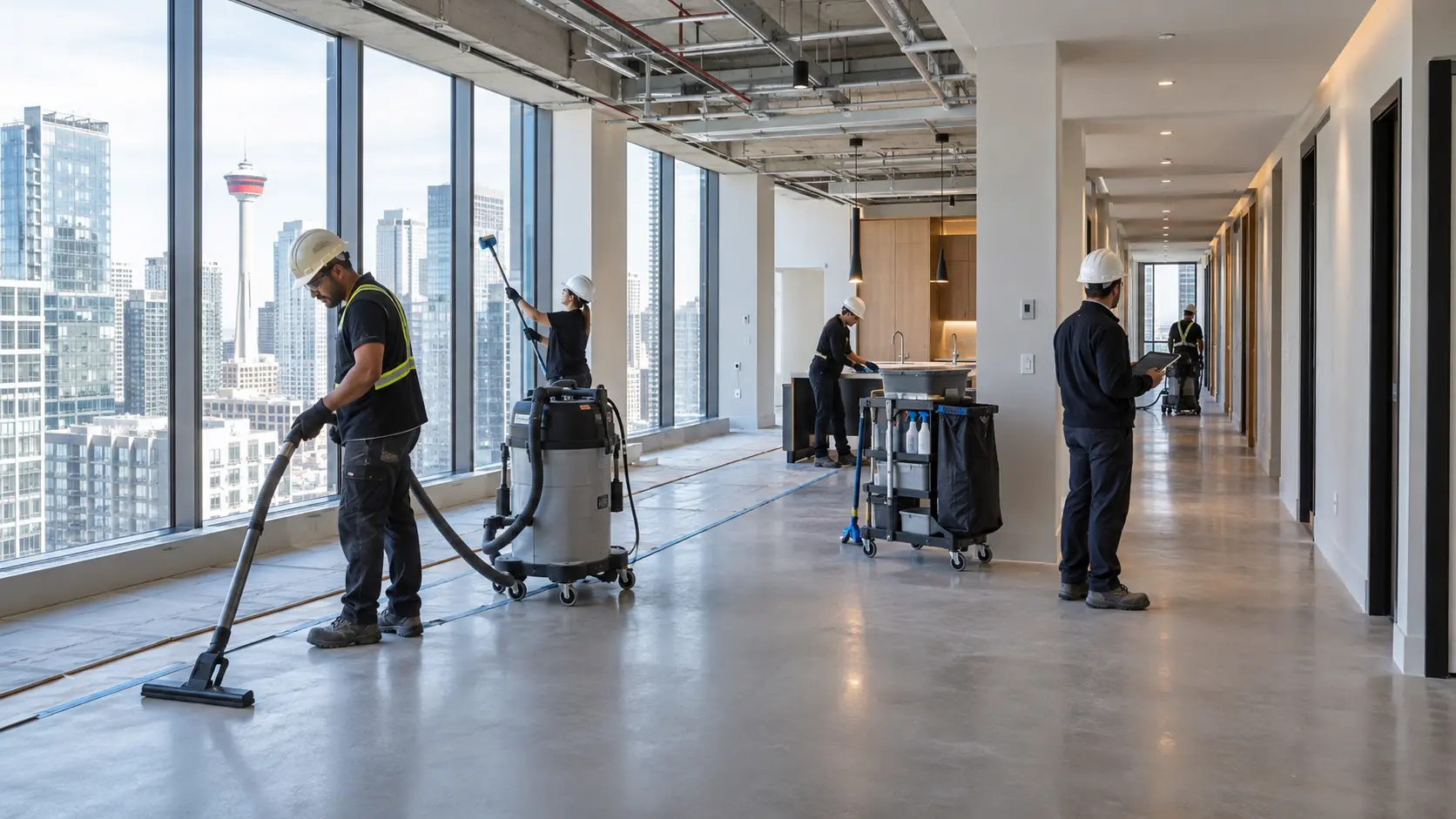
Calgary Office Renovation Cleaning: 3 Passes Tied to Trade Handovers
Keep occupied areas safe during a phased renovation by linking every cleaning pass to contractor handovers: use containment and HEPA or wet cleaning instead of dry sweeping, coordinate HVAC filter changes with the building’s mechanical team, and escalate any suspected asbestos or hazardous material to a certified specialist rather than cleaning around it. This approach follows Alberta OHS hazard-assessment rules and Health Canada indoor air guidance.
TL;DR:
- Schedule daily rough, trade complete, and final cleaning around documented handovers, then require a joint inspection before another trade enters or occupants return.
- Stop work, restrict access, and keep suspected asbestos outside the cleaning scope until testing and any required abatement by a certified specialist are complete.
- Use HEPA vacuuming and wet wiping for ordinary dust, avoid dry sweeping or compressed air, and consult a mechanical specialist before changing duct filters.
- Place portable HEPA units near dust sources and return grilles; building systems may not support HEPA filters because of pressure drop.
- Occupied zones beside active work may need light cleaning twice daily, while schedules should shift with trade delays and quieter tasks should avoid busy hours.
Table of Contents
- What post-construction and phased renovation cleaning includes for occupied offices
- Phases of cleaning for a phased renovation
- Dust, silica and asbestos: recognizing hazards and the triggers that require specialists
- HVAC and indoor air quality actions during each phase
- Coordination, responsibilities and the daily checklist for occupied sites
- How regulatory guidance shapes a compliant cleaning scope
- Customizing cleaning plans to minimize disruption and maintain productivity
- Post-phase inspection and quality assurance procedures
- Integration of cleaning schedules with renovation milestones and occupancy patterns
- A practical priority for occupied renovation cleaning
- How we support Calgary offices through a phased renovation
- FAQ
- Sources
What post-construction and phased renovation cleaning includes for occupied offices
Routine janitorial work handles everyday dust and garbage. Post-construction and phased renovation cleaning deals with something heavier: fine particulate that settles on every horizontal surface, adhesive residue, and debris that keeps arriving as each trade finishes its scope. Because a phased project runs for weeks or months, a single deep clean at the end is not enough. Cleaning needs to happen after each trade handover, or occupants end up breathing construction byproducts for the life of the project.
Common contaminants in an occupied renovation include:
- Drywall dust and joint-compound particulate from framing and finishing work
- Fine silica dust from concrete cutting, grinding or gypcrete work
- Adhesive residue, paint overspray and sealant drips on floors and fixtures
- Volatile organic compounds (VOCs) off-gassing from new paint, flooring adhesives and sealants
- General construction debris: packaging, offcuts, fasteners and dropcloths
The operational goals stay consistent across every phase: keep egress routes clear, reduce indoor air quality risk for people working nearby, and protect finishes that have already been completed so rework is not needed.
Phases of cleaning for a phased renovation
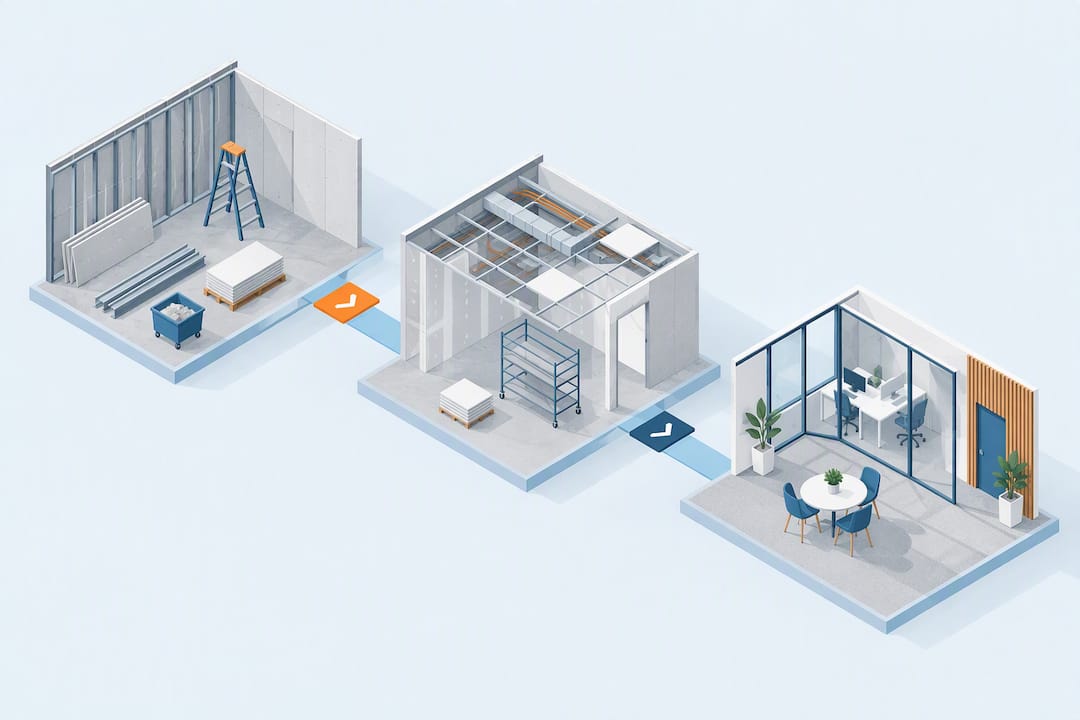
A phased project calls for three distinct cleaning passes, each tied to a specific point in the construction sequence rather than a fixed calendar date.
- Daily rough clean: remove bagged debris, sweep or vacuum loose material with a HEPA unit, and keep egress paths clear after every contractor shift. A quick inspection at the end of each day catches blocked exits or stray materials before they become a hazard.
- Trade-complete detail clean: once a trade finishes its scope in a zone, run HEPA vacuuming across all horizontal surfaces, wet-wipe fixtures and ledges, and clean supply and return grilles that may have collected dust during the work. Any portable filtration units used during that phase get their filters checked or changed before the next trade moves in.
- Turnover or final clean: before occupants reoccupy a renovated zone, complete a deep detail pass, confirm the HVAC system has had adequate run-time to flush the space, replace filters one more time, and disinfect high-touch surfaces where the space includes shared equipment or food-contact areas.
Each phase should be tied to a documented contractor handover or partial permit sign-off, not just a date on a schedule. That documentation becomes the record that the space was actually ready for occupants, and it protects the building owner if a dispute comes up later about who cleaned what and when.
Pro Tip: Keep a one-page handover log per zone, signed by both the contractor and whoever performs the detail clean, so there is no ambiguity about readiness before occupants return.
Dust, silica and asbestos: recognizing hazards and the triggers that require specialists
Not every renovation hazard belongs to a cleaning crew. Suspect asbestos-containing materials, often found in older ceiling tiles, floor tile adhesive, pipe insulation or textured finishes, require an immediate stop-work response rather than cleanup. Alberta’s renovation guidance is explicit that fibres may be released during demolition or renovation, and that materials with the potential to release fibres must be addressed before demolition proceeds.
When a trade or cleaning crew suspects asbestos:
- Stop work in the affected area immediately
- Restrict access and avoid disturbing the material further
- Arrange testing and, if confirmed, abatement by a certified specialist before any cleaning resumes
- Document the finding and the response in the renovation’s hazard assessment
Suspected asbestos removes that zone from the standard cleaning scope entirely until a certified abatement contractor clears it.
For ordinary drywall and silica dust that does not involve suspect materials, the controls are more straightforward: HEPA-filtered vacuuming and wet wiping or wet sweeping, with dry sweeping and compressed air avoided because both re-aerosolize fine particulate instead of capturing it, a method CCOHS recommends against for exactly that reason.
HVAC and indoor air quality actions during each phase
Construction dust does not stay in the zone where it was generated. It migrates through return air grilles, under partition walls and along corridors, which makes HVAC coordination one of the highest-leverage controls available. Health Canada’s guidance notes that HEPA filters remove the vast majority of particles at or above 0.3 microns, but many building HVAC systems cannot accept HEPA filters because of the pressure drop they create. That is why portable HEPA units, not ductwork retrofits, are usually the practical answer, and why an HVAC specialist should be consulted before any filter change that affects the building system.
Practical placement and timing steps include:
- Position portable HEPA units for source capture, as close to the dust-generating activity as possible
- Add a second unit near return grilles in zones where contractors are actively working
- Run units before the workday starts and for a period after it ends to clear settled particulate
- Replace standard HVAC filters on a tighter schedule during active phases, and document each change at handover
- Increase the outside-air percentage where the building system allows it, to dilute residual particulate faster
Pro Tip: Before installing any filtration device into existing ductwork, confirm compatibility with a mechanical contractor. A unit that is the wrong size for the system can affect building pressure relationships in ways that are hard to diagnose later.
Coordination, responsibilities and the daily checklist for occupied sites
A phased renovation runs more smoothly when responsibility is assigned in writing before work starts, not sorted out mid-project. At minimum, the plan should name who supplies containment barriers, who operates and verifies portable air-filtration devices, who schedules the cleaning passes against the construction timeline, and who has authority to sign off that a zone is clear for occupants.
A practical daily checklist for facility teams:
- Inspect entrances, stairwells and elevator lobbies for debris or dust tracked from the work zone
- Confirm washrooms and accessible paths remain fully usable and unobstructed
- Stage and label construction waste in a designated area, separate from occupant-facing spaces, with removal scheduled frequently enough that it never accumulates
- Record the day’s hazard assessment update and note any change in scope that affects the cleaning plan
- Confirm the next day’s contractor activity against the cleaning schedule so the right pass happens at the right time
This kind of routine inspection and prompt debris removal lines up directly with CCOHS housekeeping guidance for construction sites, which calls for unobstructed passageways and designated waste areas as standard practice.
How regulatory guidance shapes a compliant cleaning scope
Alberta’s hazard-assessment requirements, Health Canada’s air quality guidance and CCOHS housekeeping standards each translate into specific tasks: a documented assessment before each phase, HEPA-based dust control instead of dry methods, and a clear line between routine cleaning and abatement work. We build phase-based checklists and documented handovers around exactly these triggers, using HEPA equipment for every detail clean and escalating anything resembling suspect asbestos to a qualified abatement specialist rather than attempting to clean through it.
Customizing cleaning plans to minimize disruption and maintain productivity
A generic cleaning schedule rarely fits a phased renovation because every floor, department and shift pattern reacts differently to construction activity. A finance team working fixed daytime hours needs dust control completed before 8:00 AM; a call centre running extended hours needs quiet, low-disruption cleaning windows between shift changes rather than during them.
Customizing the plan starts with mapping which zones stay occupied throughout the project and which get vacated phase by phase. Occupied zones adjacent to active construction need more frequent light cleaning, sometimes twice daily, to manage dust migration before it accumulates. Vacated zones awaiting trade work can run on the standard daily-rough and trade-complete schedule without the added frequency.
Noise and access also factor in. HEPA vacuuming and wet wiping are quieter than dry sweeping, which helps when cleaning happens during business hours rather than after close. Scheduling the loudest or most disruptive cleaning tasks, like equipment staging or large debris removal, for early morning or after-hours windows keeps the work environment usable for employees who are not part of the renovation.
The plan should also flex around unexpected delays. When a trade’s work extends past its scheduled window, the cleaning pass tied to that handover shifts with it rather than happening on a fixed calendar date that no longer matches the actual state of the space. Treating the schedule as adjustable, rather than fixed, is what keeps disruption to a minimum across a project that rarely goes exactly as planned.
Post-phase inspection and quality assurance procedures
Each cleaning phase needs a verification step before the space is considered ready for the next trade or for occupants to return. A walkthrough inspection, conducted jointly by whoever performed the clean and a facility representative, confirms that surfaces are free of visible dust, that HVAC grilles are clear, and that no debris or hazardous material remains in the zone.
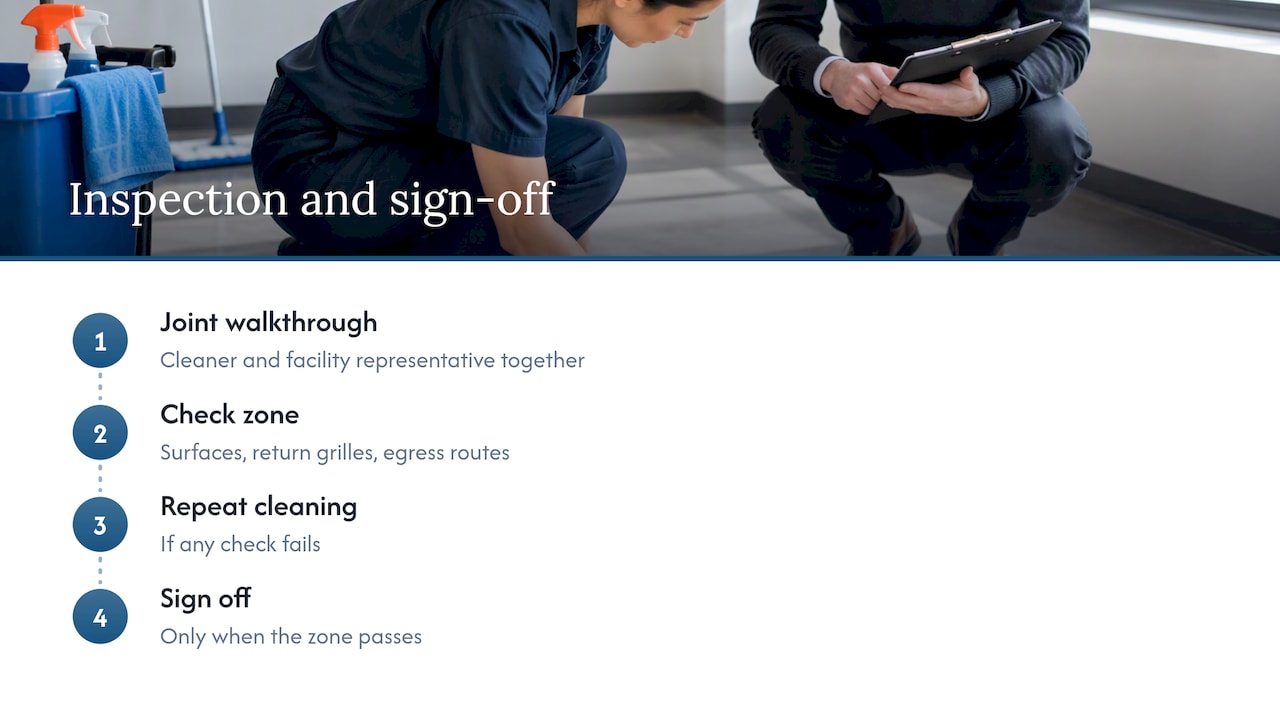
A simple pass or fail standard works best for consistency: visible dust on horizontal surfaces, dust film on return grilles, or debris in egress routes means the zone is not yet ready, and the cleaning pass repeats before sign-off. Photographing key surfaces at the end of each inspection creates a record that is useful if a dispute comes up later about the condition of a space at handover.
Quality assurance also includes confirming that filtration equipment performed as expected. If portable HEPA units ran during the phase, checking filter condition and noting whether the unit needed an unscheduled change gives useful information for planning the next phase’s run-time and filter stock.
The inspection record becomes part of the same documentation trail as the hazard assessment and the contractor handover log. Keeping all three together, dated and signed, gives facility managers a single reference point if an occupant raises a concern about air quality or cleanliness weeks after a phase was completed. It also makes the next renovation phase easier to plan, since the inspection history shows which zones needed repeat cleaning and why.
Integration of cleaning schedules with renovation milestones and occupancy patterns
Cleaning schedules work best when they are built directly into the renovation’s milestone schedule rather than treated as a separate calendar. When the general contractor issues an updated schedule, usually after permit approvals, trade sequencing changes or an unexpected delay, the cleaning plan should update at the same time, with each pass still tied to its handover trigger rather than a fixed date.
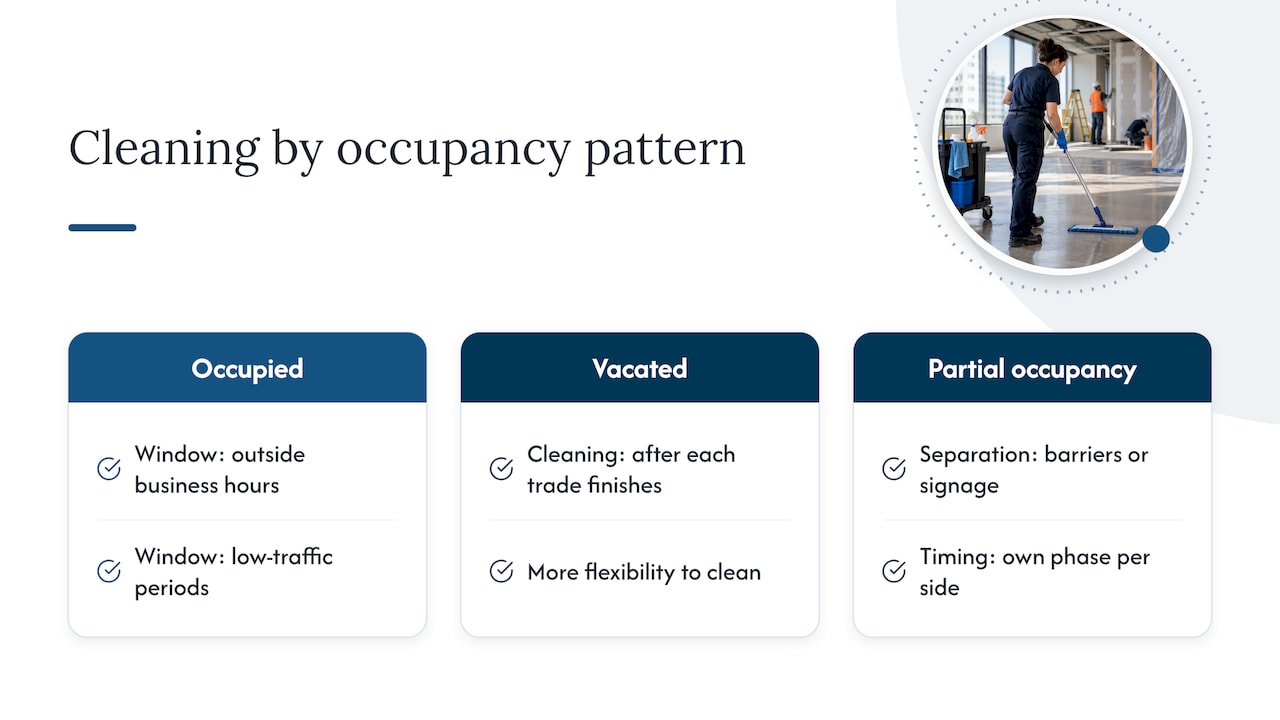
Occupancy patterns matter just as much as construction milestones. A floor that stays fully occupied through the renovation needs a different cleaning rhythm than one that is vacated entirely for the duration of a phase. For occupied floors, cleaning windows typically need to sit outside business hours or during low-traffic periods, while vacated floors offer more flexibility to clean immediately after each trade finishes.
Partial occupancy, where some departments have moved to a renovated zone while others remain in an active construction area, is the most complex pattern to manage. It calls for physical separation between zones, often temporary barriers or signage, and a cleaning schedule that treats each side of that barrier as its own project with its own phase timing. Coordinating this kind of schedule also benefits from aligning with trades managing other building systems during the same window. For HVAC and plumbing work specifically, guidance on coordinating installation timelines illustrates how tightly sequenced mechanical work needs to be tracked against the same milestone schedule that drives cleaning.
Debris removal frequency should scale with the pace of construction activity rather than sitting on a fixed weekly schedule, a point covered in more detail in guidance on debris management for Calgary property managers. Reviewing the milestone schedule weekly, and adjusting both cleaning frequency and debris pickup against it, keeps the plan responsive instead of reactive.
A practical priority for occupied renovation cleaning
The single most common oversight in phased renovation cleaning is treating HVAC coordination as a one-time setup instead of an ongoing task tied to every handover. Dust migrates through return air paths long after a trade finishes its visible work, so the filtration check that mattered at week one still matters at week twelve. Treat the cleaning plan itself as a living document: update it every time a trade’s scope changes, and revisit the hazard assessment alongside it rather than letting either one go stale.
— Jack
How we support Calgary offices through a phased renovation
A renovation that keeps the building occupied puts real pressure on facility teams: contractors come and go, dust shows up where it should not, and occupants expect the space to stay usable the whole time. We provide post-construction cleaning in Calgary using phase-based checklists, HEPA equipment for dust and silica control, and documented handovers so clients have clear records of cleaning activities.
Our services for phased renovations include post-construction detail cleaning tied to contractor handovers, flexible scheduling adjusted to occupied zones and shift patterns, HEPA-equipped dust control for drywall, silica and construction debris, and documented inspection records at each phase to support compliance.
If your renovation is moving into its next phase, request a site walkthrough for post-construction cleaning in Calgary and we will map a cleaning schedule to your contractor’s timeline.
FAQ
How do you deep clean an office after a renovation?
A post-renovation deep clean starts with HEPA vacuuming of every horizontal surface, followed by wet wiping of fixtures, ledges and vents to capture fine dust that settles after construction. HVAC grilles and return vents get cleaned and filters checked before the space reopens, and floors receive a final detail pass matched to the finish type.
Who is responsible for cleaning up after contractors finish a job?
Contractors are generally responsible for removing their own debris and major waste as part of standard construction housekeeping practices, which include keeping passageways and egress routes clear, as outlined in CCOHS construction housekeeping guidance. Fine dust removal, HEPA detailing and final turnover cleaning typically fall to a specialized cleaning provider rather than the trade itself.
What cleaning is required before handing a renovated space back to occupants?
Before occupants return, the space needs a detail clean covering all surfaces, HVAC filter replacement, and adequate system run-time to flush residual particulate from the air, consistent with Health Canada’s indoor air quality guidance. A final inspection confirming no visible dust or debris remains should happen before sign-off.
How do you know when a renovation cleaning issue needs a specialist instead of a cleaning crew?
Any suspected asbestos-containing material, or a situation where testing confirms its presence, requires a certified abatement specialist rather than a cleaning crew, per Alberta’s renovation guidance on asbestos exposure. Work should stop in the affected zone immediately until testing and, if needed, abatement is complete.
Sources
- Occupational health and safety code — hazard assessment, elimination and control (Alberta OHS)
- Guidance on improving indoor air quality in office buildings (Health Canada)
- Asbestos exposure in demolition and renovation (Alberta guidance)