High Dusting for Winnipeg Indoor Sports Facilities
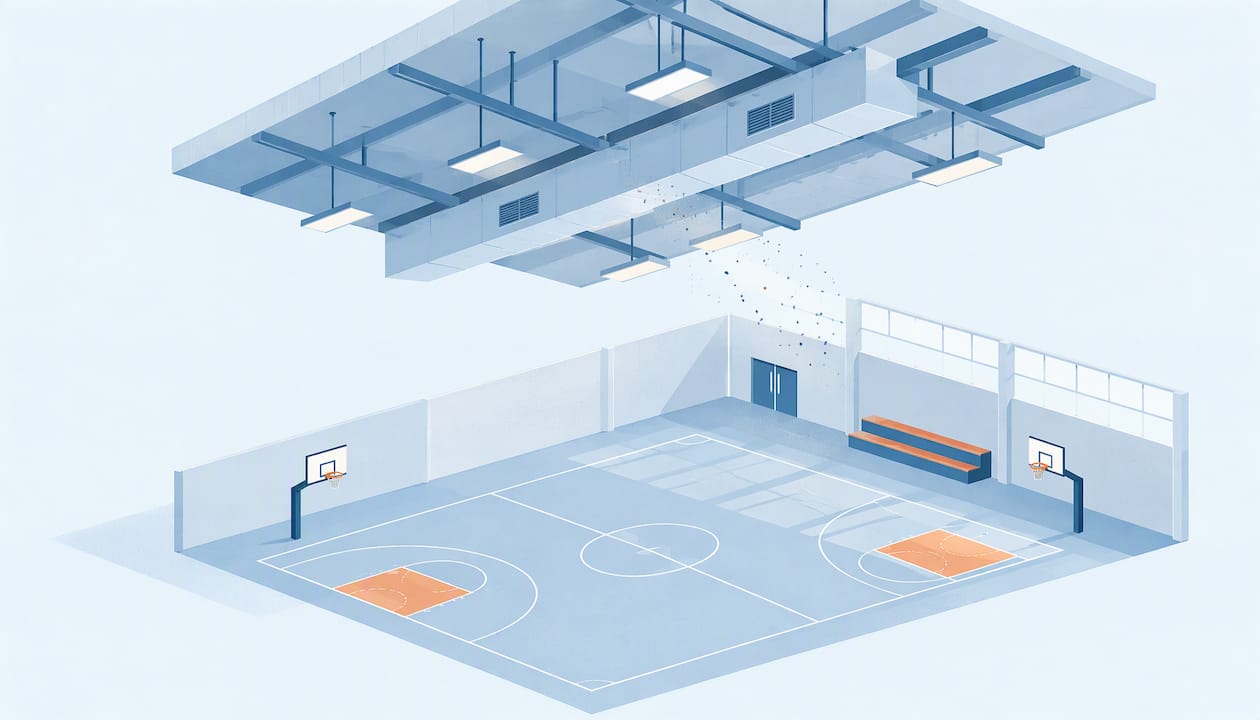
High dusting in an indoor sports facility means removing dust from everything above head height: rafters, trusses, light fixtures, ductwork, sprinkler lines, scoreboards, netting frames and ceiling decks. In Winnipeg, where arenas, fieldhouses and gyms run long, dry heating seasons with the doors shut, that dust has a steady supply and nowhere to go. Most facilities should have the overhead structure inspected every year and cleaned when the inspection says it is needed, with the work scheduled around your calendar of leagues, tournaments and ice or floor maintenance. This guide explains what collects up there, why it matters, what the safety rules say and how to plan the job.
TL;DR
- Dust settles on rafters, light fixtures and ductwork in high-ceilinged sports buildings, and ventilation and activity can move it back into the air players and spectators breathe.
- Vacuuming with HEPA-filtered equipment is the preferred method. Blowing dust down with compressed air spreads it around.
- Any work at 3 metres or higher needs a fall-protection plan, trained people and certified equipment.
- Inspect first, then clean on a schedule that fits your building, not a fixed calendar interval.
- Eshine Cleaning Services plans high dusting for Winnipeg commercial and industrial facilities around your event schedule.
Table of Contents
- Why sports buildings collect so much dust overhead
- What actually goes wrong when overhead dust is ignored
- What gets cleaned in a typical sports facility
- How professional high dusting is done
- The safety rules for working at height
- How often should a Winnipeg sports facility be high dusted
- Budgeting and what affects the price
- Our perspective: treat overhead dust as maintenance, not an emergency
- Plan your facility’s high dusting with Eshine
- Questions facility managers ask
- Sources
Why sports buildings collect so much dust overhead
A warehouse and a hockey arena have more in common than you might expect: tall volumes, large mechanical systems and a roof structure that is rarely touched. A sports facility adds its own sources on top.
- People and movement. Hundreds of players and spectators bring in grit, fibres, skin cells and outdoor soil on their footwear. Heated air rises and carries fine particles up with it.
- Air handling. Large ventilation systems move air constantly, and fine particles settle on the first flat surface they reach: beams, ledges, duct tops and light housings.
- Equipment and surfaces. Rubber flooring, turf infill, wood floor refinishing, gym chalk, tape and equipment wear all release particles.
- Winter. Winnipeg buildings are sealed for months. With less fresh air coming in, less dust is flushed out.
- Combustion in ice arenas. Fuel-powered resurfacers produce exhaust. Manitoba’s public health guidance on arena air quality notes that carbon monoxide and nitrogen dioxide are the concern, and that inadequate ventilation makes things worse.
Dust is not the main hazard in that last case, but it belongs to the same picture. Manitoba’s arena guidelines, in Air Quality Guidelines for Arena Operations in Manitoba, are written for ice-based arenas and for protecting public health. A facility that keeps overhead surfaces clean is removing one more thing the ventilation system has to cope with.
What actually goes wrong when overhead dust is ignored
Air quality and comfort
Health Canada’s guidance on improving indoor air quality in office buildings sets out three strategies: reduce or eliminate contaminant sources, ventilate effectively, and filter air in the HVAC system, often with filters rated MERV 13 or higher. It is written for offices, but the logic carries over to any large, occupied building. High dusting belongs to the first strategy: it removes a reservoir of particles before they are disturbed.
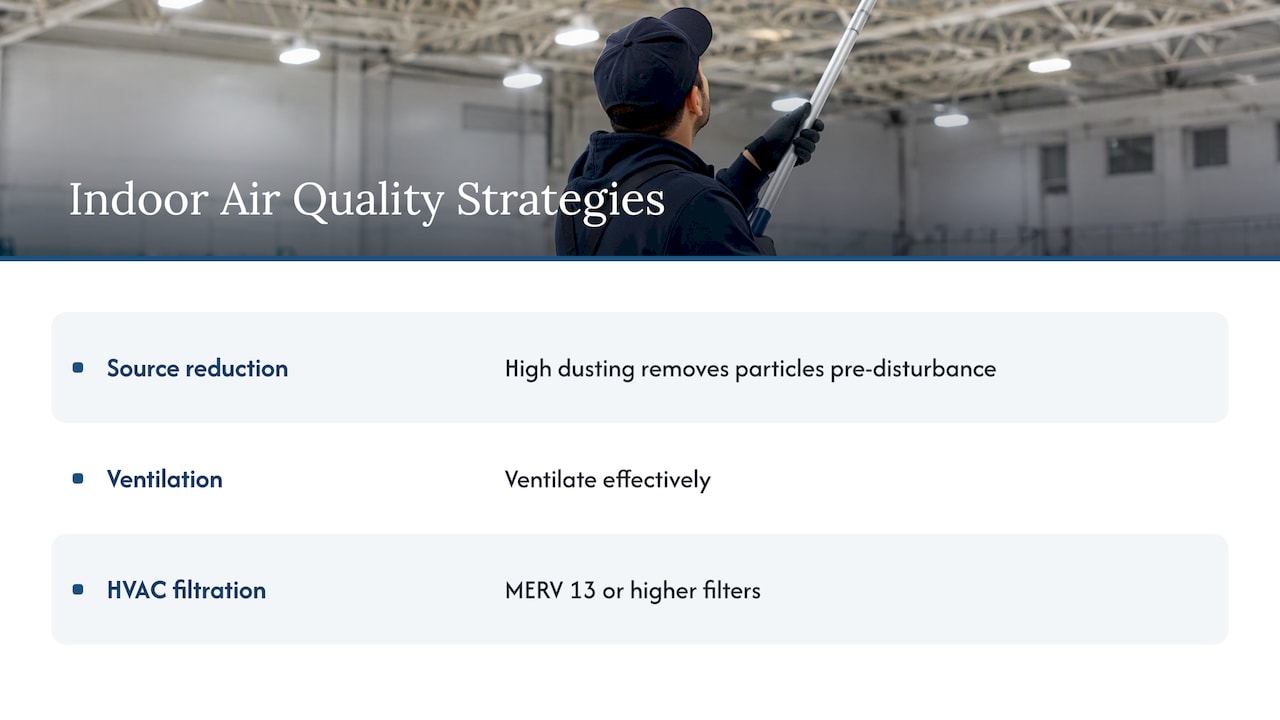
The same guidance says the best approach is to prevent problems and to deal with issues as soon as they are found. For a facility manager, that argues for a regular programme over an emergency clean after a complaint.
Safety and housekeeping
Manitoba’s own housekeeping safety talk treats tidy, clean work areas as basic injury prevention, not a cosmetic task. In a sports building, dust that drifts down lands on court surfaces, bleachers, walkways and equipment, where it can make surfaces slick or gritty. Dust on lighting also dims output, and accumulated debris near hot fixtures or electrical equipment is a fire-safety concern that any facility manager should take seriously.
Appearance and the visitor’s first impression
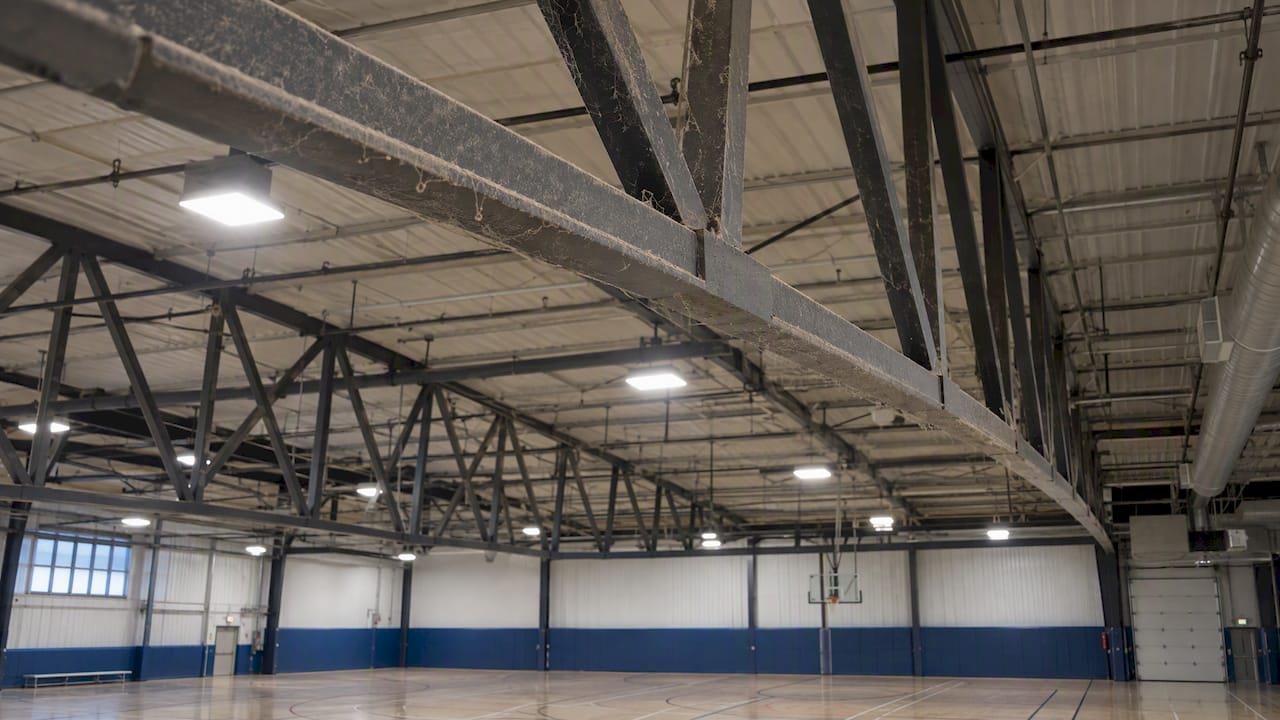
Tournament organizers, parents and visiting teams notice cobwebs and grey trusses. A clean ceiling is not the reason families pick a facility, but a dirty one is a reason they remember.
A caution about ducts
Be wary of anyone who sells duct cleaning as a cure-all. A National Research Council of Canada publication on duct cleaning and indoor air quality cautions that dusty ducts do not always mean worse indoor air, and that poorly done cleaning can resuspend pollutants. The better approach is overall maintenance: filtration, source control and clean surfaces. Exposed ductwork is part of high dusting, but the exterior of the system is what we address. Internal HVAC system cleaning is a separate job for the people responsible for your mechanical systems.
What gets cleaned in a typical sports facility
The list depends on the building. This table shows how the work usually divides.
| Facility type | Typical overhead surfaces | Planning points |
|---|---|---|
| Ice arena | Roof trusses, lighting, ventilation and heating equipment, scoreboard, viewing-area ceilings | Work around ice maintenance and ventilation procedures; coordinate with the arena’s air quality plan |
| Fieldhouse or indoor turf | Exposed deck and steel, high-bay lighting, netting frames, duct runs | Long sight lines and very high ceilings; plan access equipment and floor protection |
| Gymnasium or fitness centre | Light fixtures, ceiling tiles and grids, exposed ducts, basketball backboard supports | Short windows between classes and leagues; evening or overnight work |
| Community or multi-purpose centre | Rafters, ceiling fans, stage lighting, pipes | Mixed use means mixed schedules; see our church and community centre cleaning page |
| Event or tournament venue | Concourse ceilings, signage, lighting rigs | Clean ahead of major events; our event venue cleaning page covers the wider picture |
How professional high dusting is done
Method matters more than speed. Here is the sequence a well-run job follows.
- Walk-through and inspection. Look at the structure, the fixtures, the ventilation and the level of buildup. Note anything fragile, such as sensors, sprinkler heads, and light covers, and anything that needs the facility’s own maintenance staff.
- Plan the access. Decide what equipment reaches each area and how the floor and any fixed equipment will be protected.
- Protect the space. Cover or move sensitive items, such as scoreboards, sound equipment, and floor surfaces, and close off the area being cleaned.
- Work top-down. Clean the highest surfaces first so that nothing falls on areas already done.
- Capture, don’t scatter. Use HEPA-filtered vacuum equipment and damp wiping where appropriate. The federal guidance on HVAC maintenance and cleaning is clear in the way it frames the risk: compressed air blowing can redistribute contaminants into the air, so professionals prioritize vacuuming over blowing.
- Clean the floor last. Once the overhead work is complete, floors, seating and ground-level surfaces get their regular clean. Our floor care for Winnipeg commercial facilities service is built for that final step.
- Document and review. Record what was cleaned, what was found and when the next inspection should happen.
Manitoba’s arena guidelines recommend damp wiping or HEPA vacuuming for high-level dust, especially in older buildings where settled dust may carry historical residues. If your facility is older, mention it when you request a quote.
The safety rules for working at height
This is where a cheap quote can become an expensive problem. Work above ground level is among the most regulated tasks in any building.
Under the federal Canada Occupational Health and Safety Regulations, where there is a risk of falling and the fall-protection plan calls for a personal fall-protection system, the employer must provide one to every person exposed, and the components must meet the relevant CSA standards, such as the Z259 series. The federal regulations apply to federally regulated workplaces. Most Winnipeg sports facilities fall under Manitoba’s workplace safety and health law instead, which has its own fall-protection requirements, so confirm the current rules with Manitoba’s workplace safety and health authority before you hire anyone, and ask the contractor to explain how they comply.
What to ask a contractor in practice:
- Are your people trained for work at height, and can you show it?
- What access equipment do you use in a building with my ceiling height?
- What is your fall-protection plan for this building?
- Are you insured, and does your certification cover this kind of work?
- How do you capture dust rather than disturb it?
Training and equipment planning for elevated work is a topic in its own right. This overview of health and safety practices for service businesses is a reasonable starting point for understanding why tool management and work planning matter.
How often should a Winnipeg sports facility be high dusted
There is no single correct interval, and anyone who gives you one without seeing the building is guessing. Base the schedule on what an inspection finds. Factors that push the frequency up:
- Very high attendance or round-the-clock use.
- Proximity to heavy traffic routes or industrial areas.
- Fuel-powered equipment operating indoors.
- Open-air or older ventilation systems with limited filtration.
- Visible buildup on lights and ledges, or a dusty smell during heating season.
A practical rhythm many facility managers settle into: an annual inspection, a full overhead clean when the inspection calls for it, and a spot clean of lighting and high-visibility areas before major events. Our high dusting services guide for Winnipeg facilities explains how we think about scheduling based on inspection results.
Timing the work around your calendar
Summer is the usual choice for arenas, when ice is out and bookings are lighter. Fieldhouses and gyms are busiest through the winter, so work often goes to evenings, early mornings, or the quieter gaps between seasons. Plan it far ahead and put it in your facility calendar next to ice installation, floor refinishing and major tournaments.
Budgeting and what affects the price
We do not publish set prices for high dusting, because the cost depends on the building. The variables are the same wherever you hire:
- Ceiling height and the type of access equipment required.
- Floor area and the number of fixtures, ducts and beams.
- Level of buildup and how long it has been since the last clean.
- How much of the floor and equipment must be protected.
- Working hours: overnight or early-morning work takes more coordination.
- Whether the facility must stay partially open.
A fair quote follows an inspection and lists what is included. For a broader view of how to weigh price against what you get, read our piece on commercial cleaning cost versus value.
Our perspective: treat overhead dust as maintenance, not an emergency
We have been cleaning commercial buildings in Winnipeg and Calgary since 2012, and we are a privately owned company, not a franchise. Across more than 700 projects, the pattern in high dusting is consistent: the facilities that have the easiest time are those that treat it as a line in the maintenance plan.
Here is what we would tell a facility manager:
- Start with an inspection, not a quote. Until someone has looked at the rafters and fixtures, nobody can say what the job is.
- Plan around your events. The best time to clean is the time that does not disrupt your users. We build schedules to fit the facility.
- Insist on safe work at height. We are certified and insured, and we use advanced equipment. If a contractor cannot explain their fall-protection approach, move on.
- Keep it connected. Overhead cleaning, floor care and regular janitorial work each support the others. Done together, they keep the building consistent.
- Customize. An ice arena, a fieldhouse and a community gym are different buildings, and a standard package serves none of them well.
If you manage a building with heavier industrial-style dust sources, our page on industrial dust accumulation in Winnipeg explains the wider issues. For the benefits of regular overhead cleaning in commercial and industrial settings, see our high dusting benefits overview.
— Jack
Plan your facility’s high dusting with Eshine
Eshine Cleaning Services provides high dusting for Winnipeg commercial and industrial facilities, alongside floor care, commercial cleaning and post-construction cleaning. Each plan is tailored to the building, with flexible scheduling and ongoing quality control. Tell us about your facility and its calendar through the Eshine Cleaning Services home page and we will arrange an inspection and a quote.
Questions facility managers ask
Is high dusting the same as duct cleaning?
No. High dusting cleans exposed overhead surfaces such as beams, fixtures, pipes and the outside of ducts. Cleaning inside an HVAC system is a different specialty, and research from the National Research Council suggests it does not always improve indoor air on its own.
Will high dusting make my arena’s air quality compliant?
Not by itself. Manitoba’s arena guidance focuses on exhaust gases such as carbon monoxide and nitrogen dioxide, and on ventilation and monitoring procedures. Clean surfaces support that work but do not replace it.
Do we need to close the facility?
Usually only the area being cleaned. Many jobs can run overnight, early in the morning or between bookings. The plan should be agreed before work starts so your schedule is protected.
How do I know if my building needs it now?
Look up. Visible grey buildup on beams and light fixtures, dust falling when fans start, or complaints about air quality are all signs. An inspection will tell you more than a guess.
Sources
- Guidance on improving indoor air quality in office buildings, Health Canada
- Arena Air Quality, Province of Manitoba
- Air Quality Guidelines for Arena Operations in Manitoba
- Housekeeping safety talk, Province of Manitoba
- Duct cleaning and indoor air quality, National Research Council of Canada
- HVAC system maintenance and cleaning, Canada.ca
- Canada Occupational Health and Safety Regulations, section 12.09
- Health and safety in industry: service business guide