Post-Construction Cleaning for Winnipeg Warehouses and Distribution Centres
Post-construction cleaning for Winnipeg warehouses and distribution centres prepares large commercial spaces for racking, inventory, equipment, employees, and daily traffic. Eshine Cleaning Services addresses the different cleaning requirements across open warehouse floors, loading areas, high surfaces, and finished employee spaces.
The scope depends on the facility’s construction stage and intended handoff condition. A newly built shell, an expanded distribution centre, and a warehouse renovated during active operations require different cleaning phases, access controls, and sequencing.
What Makes Warehouse Post-Construction Cleaning Different?
Warehouse cleaning involves more than covering a large floor area. Dust may settle on structural components, ledges, racking, dock areas, mechanical systems, and surfaces positioned well above the occupied level. Cleaning methods used in offices may not provide the reach or production rate required in an open warehouse.
The building layout also affects how the work proceeds. Racking, conveyors, partitions, security cages, and installed equipment may divide the floor into narrow or restricted areas. Cleaners must account for these obstructions when planning equipment access and cleaning sequences.
Operational deadlines create another consideration. A facility may need to receive inventory, complete equipment commissioning, or begin employee training shortly after construction ends. Cleaning must occur after contaminating work but before pallets, products, and regular traffic restrict access.
Renovations in active warehouses require additional coordination. The facility may need separated work zones, protected inventory, controlled traffic routes, and scheduled cleaning windows. The scope should identify which areas remain operational and which surfaces cannot be reached safely without disrupting warehouse activity.
Areas Included in a Warehouse Cleaning Scope
A warehouse cleaning scope should divide the facility into functional areas rather than treating the entire building as one uniform space. Each area has different surfaces, access conditions, and turnover requirements.
Warehouse floors and traffic lanes
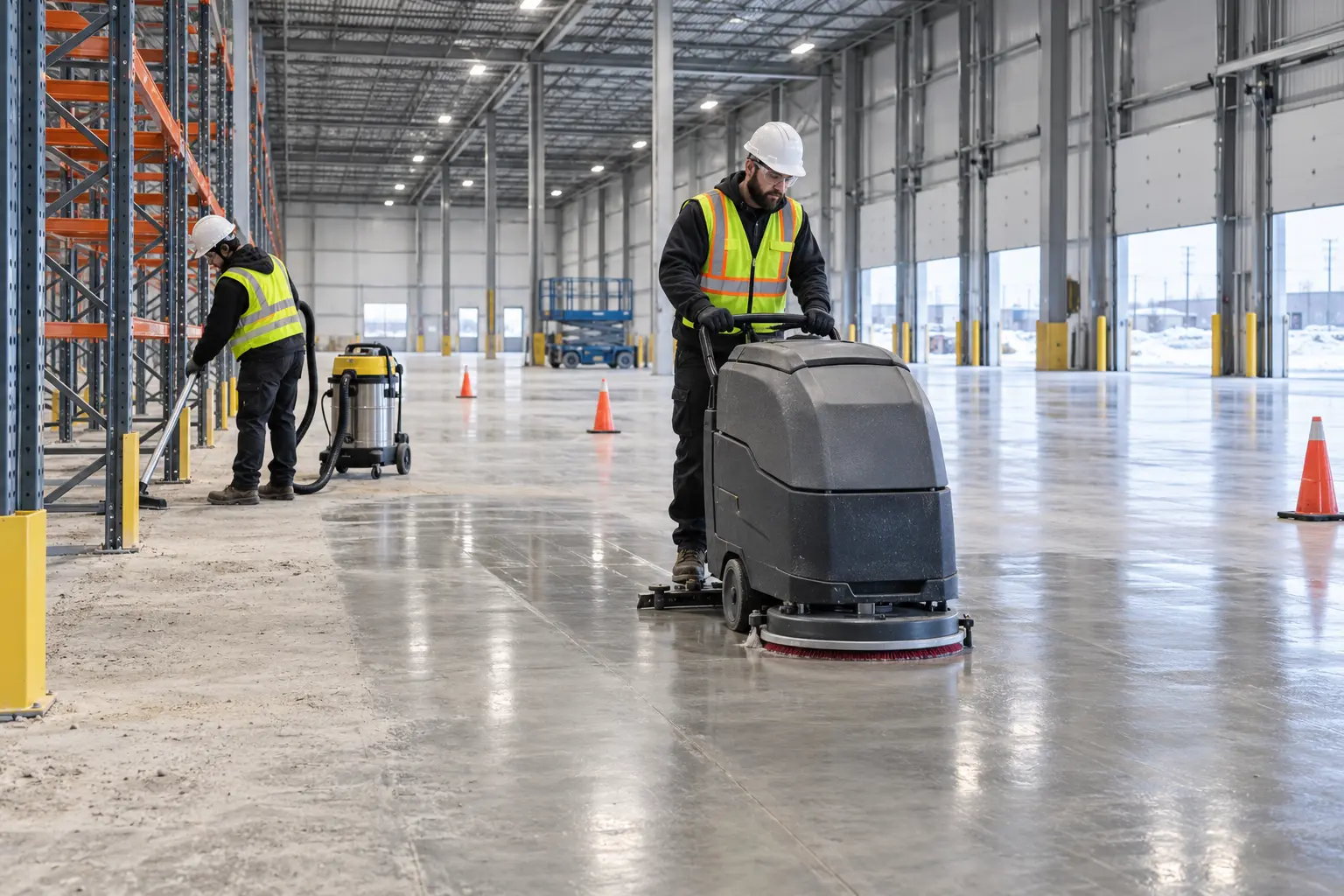
Large concrete floors collect fine construction dust, footprints, tire marks, packaging fragments, and residue from installation work. Dust may remain in control joints, along walls, beneath racking, and around columns even when the main floor appears clean.
The appropriate cleaning method depends on the slab finish, floor coating, joints, surface condition, and type of contamination. Vacuuming, damp cleaning, or auto-scrubbing may be suitable when the selected method complies with the floor manufacturer’s or installer’s requirements.
Routine cleaning does not automatically include removing paint, adhesive, concrete splatter, curing compounds, or other material bonded to the floor. Adhered residue must be identified first so an approved removal method can be tested or added to the scope.
Marked traffic lanes and finished floor coatings also need compatible methods. Cleaning should not begin until the project contact confirms that coatings, sealers, and repairs have cured according to the installer’s requirements.
Loading docks and receiving areas
Loading docks often remain active during the final stages of construction. Exterior dirt, road salt, moisture, pallet fragments, packaging, and trade traffic may repeatedly contaminate cleaned receiving areas.
The scope may cover accessible dock floors, doors, frames, walls, ledges, and surrounding surfaces. Accessible dock pits may also be included when authorized personnel have isolated the affected equipment and confirmed safe entry conditions.
Cleaning around dock levellers, restraints, controls, and other installed systems does not include mechanical servicing or repairs. Areas that cannot be isolated or accessed safely should be recorded as exclusions.
Scheduling dock cleaning too early may lead to repeat work. Whenever possible, final cleaning should occur after major construction deliveries end and before regular receiving operations begin. If dock access must remain open, the project team should separate active and cleaned zones.
Offices, washrooms, and employee areas
Warehouse offices and employee areas contain more finished materials than the open warehouse. Cleaning may involve built-in work surfaces, cabinets, doors, interior glass, fixtures, flooring, washrooms, lunchrooms, and change areas included in the scope.
These rooms often require greater detail because employees may use them immediately after handoff. Dust may settle inside cabinets, along baseboards, on partitions, and around fixtures while nearby warehouse work continues.
Finished rooms should be cleaned after dusty work in connected areas has ended or been contained. Otherwise, airborne dust and construction traffic may contaminate surfaces after their final clean.
Accessible ledges and overhead surfaces
Warehouse dust collects on beams, pipes, duct exteriors, conduit, light fixtures, wall ledges, door tracks, and the tops of structural components. Disturbing these surfaces after floor cleaning may release dust back into the occupied area.
Overhead cleaning should occur before the final floor pass. The scope must identify which surfaces are included, which are safely accessible, and what access equipment the facility permits. Eshine’s high dusting cleaning in Winnipeg addresses elevated surfaces where suitable access and site conditions are available.
Routine high dusting may include accessible exterior surfaces of ducts, diffusers, pipes, and other building components. It does not include internal duct cleaning, filter replacement, mechanical servicing, or opening equipment unless these tasks are separately assessed and approved.
Suspected hazardous contamination also falls outside routine high dusting. Work in the affected area should pause until an appropriately qualified party assesses the material and confirms how the area may be handled.
Managing Construction Dust in Large Facilities
Construction dust spreads easily through a warehouse because open layouts allow air movement across long distances. Drywall work, concrete drilling, cutting, racking installation, and overhead work may contaminate areas beyond the immediate work zone. HVAC testing may also dislodge dust from accessible vents and surrounding surfaces.
Cleaning should generally progress from high surfaces to low surfaces. Overhead dust is removed first, followed by walls, ledges, installed surfaces, edges, and floors. This sequence prevents debris from elevated areas from settling on a floor that has already received its final pass.
Active cutting, sanding, and drilling should be complete in the released zone before final cleaning begins. When construction continues nearby, closed barriers, controlled entry points, and protected traffic routes help limit cross-contamination. The project contact should document when a cleaned zone is reopened and which trades require access.
Additional settling or touch-up time may be necessary when airborne dust remains after overhead cleaning, HVAC commissioning, or incomplete containment. The scope should state whether it includes a settling period, final dust check, or separate return visit.
Cleaning Around Racking and Installed Equipment
Racking creates a scheduling tradeoff. Cleaning before installation provides open floor access and allows larger areas to be completed efficiently. However, rack assembly may create drilling dust, metal fragments, packaging, footprints, and lift traffic that require another cleaning pass.
Cleaning after installation captures that contamination but limits access beneath and between uprights. The project team should decide whether the sequence will include an open-floor clean followed by localized touch-ups or a complete clean after installation.
Cleaning the racking itself is separate from cleaning the surrounding floor. Rack uprights, beams, shelves, and top surfaces are included only when listed in the scope and safely accessible.
Renovated facilities may contain inventory that cannot be removed from the work area. The warehouse operator should relocate or protect stored products before cleaning starts. Covered, blocked, or occupied surfaces may need to be excluded when cleaners cannot reach them without handling inventory.
Installed conveyors, charging stations, compactors, controls, and other equipment create similar restrictions. Cleaning may address accessible floors and approved exterior surfaces around equipment. It does not include internal cleaning, machinery maintenance, spill remediation, or moving installed systems.
The facility representative should identify operational hazards, restricted zones, and equipment status. Authorized site personnel remain responsible for required isolation and lockout procedures. The cleaning provider must still assess the safety of its cleaning methods, access equipment, and work area before proceeding.
Protective film, packaging, installation materials, and trade waste should be assigned before cleaning begins. If responsibility is unclear, these materials may obstruct surfaces or remain in place at handoff.
When Should Warehouse Cleaning Be Scheduled?
Warehouse post-construction cleaning should be scheduled after dust-producing work is complete in the released area but before inventory and regular operations restrict access. The timing depends on racking installation, equipment commissioning, floor curing, overhead work, and the turnover sequence.
Large facilities may benefit from phased cleaning. Completed zones may receive progressive cleaning while construction continues elsewhere. A final clean can then address released areas after trade traffic, installations, and remaining corrections end.
Warehouses that remain operational may require temporary shutdown windows or zone releases coordinated around receiving, shipping, equipment movement, and employee traffic. These access periods should provide enough time to complete the agreed cleaning without regular operations immediately recontaminating the area.
The project schedule should also allow time for a walkthrough and documented touch-ups before pallets, products, or operating teams enter the space. If delays or returning trades change the site condition, the project contact should document and authorize any additional cleaning.
Preparing the Facility for Operational Handover
Operational handover requires a defined cleaning standard rather than a general request to make the warehouse ready. Before work begins, the project contact should confirm the released zones, included surfaces, floor requirements, overhead cleaning limits, restricted areas, available utilities, access hours, and review process.
Construction tools, unused materials, trade waste, and movable obstructions should be removed from areas scheduled for final cleaning. Permanent or temporary lighting must provide enough visibility to assess floors, ledges, glazing, fixtures, and finished rooms.
After cleaning, one authorized representative should inspect the agreed scope and provide a consolidated deficiency list. The walkthrough record should identify any blocked, inaccessible, unfinished, excluded, or uncleaned areas. This prevents partial completion from being mistaken for acceptance of the entire facility.
Cleaned zones should then be protected from unnecessary trade traffic while racking, inventory, technology, and operational teams move into the facility. Cleaning sign-off confirms the observed condition of the included surfaces at the time of review. It does not guarantee regulatory approval, workplace inspection results, equipment performance, or the completion of work assigned to other contractors.
Winnipeg Warehouse Post-Construction Cleaning from Eshine Cleaning Services
Eshine Cleaning Services plans warehouse cleaning around the facility layout, construction stage, surface conditions, access limitations, and operational deadline. Our Winnipeg post-construction cleaning scope may coordinate floor cleaning, accessible surface detailing, employee-area cleaning, loading-zone work, and approved high dusting.
As a commercial cleaning provider, Eshine Cleaning Services distinguishes routine post-construction cleaning from equipment maintenance, hazardous-material removal, spill remediation, and other specialized work outside the cleaning scope.
Frequently Asked Questions
Warehouse cleaning requirements depend on the size, layout, installation schedule, and condition of the facility. The answers below address common planning decisions for newly constructed and renovated warehouses.
What does warehouse post-construction cleaning include?
Warehouse post-construction cleaning may include accessible floors, traffic lanes, loading areas, offices, washrooms, employee spaces, ledges, fixtures, and overhead surfaces identified in the scope. The exact work depends on surface conditions, access, installed systems, and the required handoff standard.
Hazardous-material cleanup, equipment maintenance, spill remediation, pest control, and construction repairs are not part of routine post-construction cleaning. If suspected hazardous material is found, work in the affected area should pause until an appropriately qualified party assesses and clears it.
Can cleaning begin before warehouse racking is installed?
Cleaning may begin before racking installation when the project requires an open-floor clean. This provides better access and may improve cleaning efficiency across large floor areas.
However, drilling, lift traffic, packaging, and assembly work may contaminate the floor afterward. The scope should state whether localized cleaning after rack installation is included or scheduled separately.
How long does post-construction cleaning take in a large warehouse?
The timeline depends on total floor area, dust levels, ceiling height, included rooms, surface conditions, installed racking, equipment restrictions, access hours, and the required cleaning standard. A large open shell may differ substantially from a smaller facility filled with racking and completed employee areas.
A site assessment is needed to estimate labour, equipment, cleaning phases, and completion time. Square footage alone does not provide a reliable timeline.
Does warehouse post-construction cleaning include high dusting?
High dusting may be included when overhead surfaces are identified in the scope and safely accessible with approved equipment. The work may address accessible beams, pipes, duct exteriors, conduit, fixtures, and ledges without opening or servicing building systems.
Ceiling height, obstructions, active equipment, fall hazards, and site access determine which surfaces can be reached. Any excluded or inaccessible overhead areas should be documented before cleaning begins.
 Loading docks and receiving areas


