


Post-Construction Cleaning After Commercial HVAC Upgrades in Calgary
After an HVAC replacement or mechanical retrofit, the cleaning job is about the building surfaces the trades leave behind: ceiling tiles and grids, light fixtures, floors, the faces of grilles and diffusers, and the routes crews used to reach the plant. Cleaning is a separate scope from duct cleaning, balancing, commissioning and equipment repair. Keeping those scopes apart is what lets a Calgary building reopen on schedule without dust coming back through the space a week later.
This guide is for general contractors, mechanical contractors and building managers in Calgary. It explains what the cleaning covers, what it does not, the order of work and what to confirm before the space returns to normal use.
TL;DR
- HVAC work opens ceilings, moves fine dust above and around the work area, and leaves debris at new grilles, diffusers and plant access routes. Plan a dedicated cleaning scope for it.
- Surface cleaning is not duct cleaning, air balancing, commissioning or equipment repair. Each has its own trade and sign-off.
- Clean from the top down, and use damp or wet wiping and filtered vacuums rather than dry sweeping, so dust is captured and not redistributed.
- Before reopening, confirm that debris is removed, surfaces are cleaned for the contaminants present and mechanical systems are confirmed clean, balanced and operational by the right trades.
- Check surface readiness and manufacturer restrictions before any wiping starts.
Table of Contents
- Why HVAC upgrades leave a different kind of mess
- What is in scope, and what is not
- Plant access routes and the areas people forget
- Order of work: top to bottom, dry capture before wet
- Methods that keep dust from spreading
- Surface readiness and manufacturer restrictions
- Heading to reopening: what the building manager checks
- Planning the cleaning around the HVAC schedule
- Our perspective
- Book the cleaning with the project
- FAQ
- Sources
Why HVAC upgrades leave a different kind of mess
A new rooftop unit or a fan coil replacement does not look like a gut renovation, but the dust it produces travels. Ceiling tiles come out, the grid is disturbed, insulation and fasteners are handled, openings are cut for new drops, and the plenum above the ceiling gets worked on by several trades in sequence. Whatever settled on top of tiles and grids for years is shaken loose along with the new debris.
That dust settles in predictable places:
- Ceiling grids and tile faces, especially around the openings where equipment was swapped.
- Light fixtures and lenses, which sit in the same plenum.
- Grille, diffuser and return faces, which trap fine particles on their louvres and borders.
- Floors and thresholds along the route from the loading area to the plant room or the rooftop hatch.
- Horizontal surfaces at working height: window sills, partition tops, shelving, millwork and the tops of frames.
In Calgary, the work also tends to happen in occupied or partly occupied buildings, and in tower floors where the next trade or the tenant is waiting. That raises the cost of dust that is missed. For how this plays out in towers specifically, see our guide to post-construction cleaning in Calgary high-rise offices, and for why fine particles keep reappearing, why post-construction dust lingers in Calgary.
What is in scope, and what is not
The most common source of disputes on mechanical jobs is a scope that nobody wrote down. Here is a clean way to split it.
| Task | Who normally owns it | Where cleaning fits |
|---|---|---|
| Removing construction debris and offcuts | Mechanical or general contractor | Done first, so the cleaning crew is not working around materials |
| Cleaning inside ducts and air-handling components | Specialist HVAC contractor | Not part of surface cleaning |
| Air balancing and commissioning | Balancing and commissioning agents | Cleaning is scheduled around them, not instead of them |
| Repair or adjustment of equipment | Mechanical contractor or manufacturer | Never part of a cleaning scope |
| Ceiling tile, grid, fixture and floor cleaning | Cleaning contractor | Core of the job |
| Wiping the accessible faces of grilles and diffusers | Cleaning contractor, within manufacturer guidance | Included once surfaces are confirmed ready |
| Plant access routes: corridors, stairs, hatches landings | Cleaning contractor | Cleaned after equipment moves are finished |
We do not clean inside HVAC systems, and a surface-cleaning contract should never imply that it does. This is more than a legal distinction. Research from the National Research Council of Canada found that duct-cleaning activities have been reported to increase airborne particle concentrations, and a separate NRC review notes that disturbing ducts can make dirt and other pollutants airborne. Duct work belongs with the people who have the containment and monitoring to do it, and their sequence has to be agreed with the surface clean.
What Calgary tenant manuals say
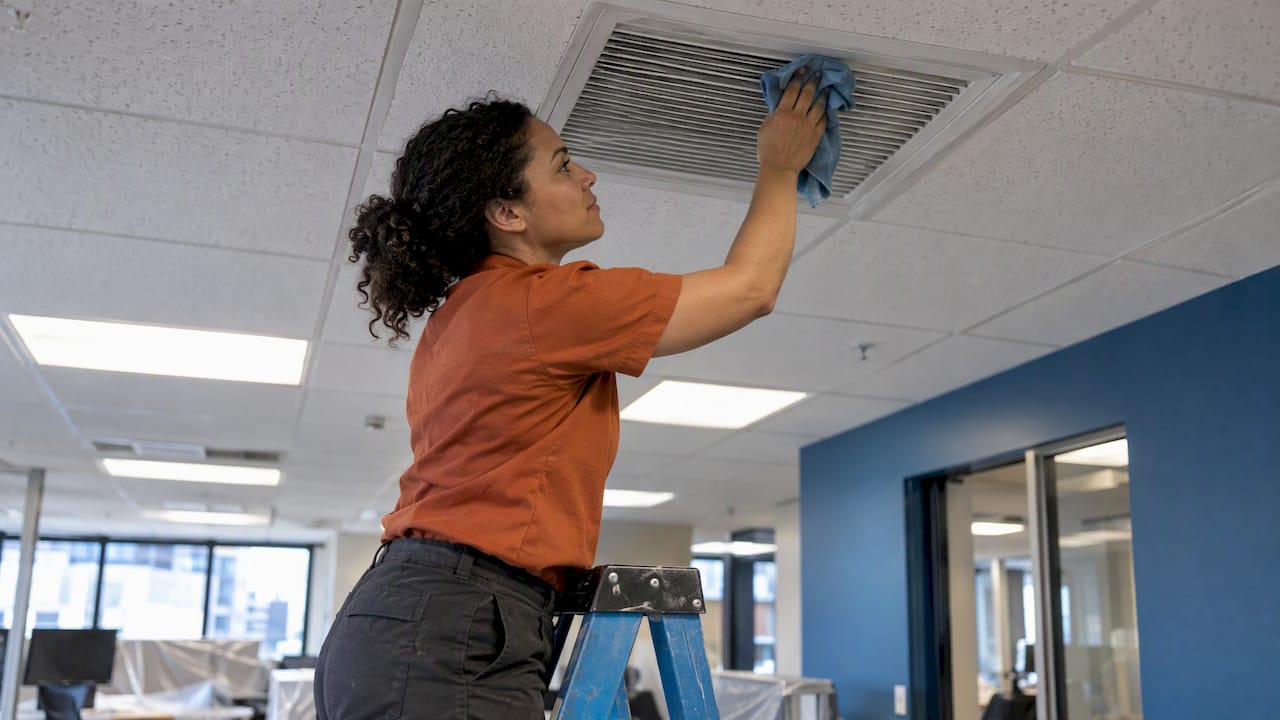
Landlord requirements are a useful reference for what “done” means. The 2022 tenant design and construction manual for Brookfield Place Calgary makes tenants responsible for post-construction cleaning, including light fixtures, ceiling tiles, floors and HVAC components such as supply diffusers and return grilles. It also requires arrangements to protect on-floor air conditioning units before construction begins, and the units must be returned to their original state at the tenant’s expense. Your building will have its own manual, so read it before you price the cleaning.
Plant access routes and the areas people forget
The visible work area is only part of the dust path. Equipment moves through the building, and every route leaves a trail.
Walk the full path with the mechanical contractor before cleaning starts:
- Loading dock or service entrance and any protective flooring that was laid down.
- Freight elevator and its car, including door tracks and thresholds.
- Corridors and stairwells used for equipment, where wheel marks, grit and packaging fragments collect.
- Mechanical room floors and landings, limited to the surfaces that are safe and appropriate for a cleaner to reach.
- Adjacent suites or tenant spaces that took dust through shared plenums or open doors.
On multi-tenant properties, the neighbouring suite is where complaints come from. Our notes on multi-tenant commercial post-construction cleaning in Calgary cover how to handle shared corridors and handovers.
Order of work: top to bottom, dry capture before wet
The order matters more than the equipment. A reliable sequence on an HVAC job looks like this.
1. Debris out, area confirmed finished. Bulk material, packaging, offcuts and tools go first. Do not start fine cleaning while a trade is still cutting or fastening above the ceiling. If the mechanical contractor returns, the dust returns with them.
2. Protect what must not get wet. Cover or mask controls, thermostats, open connections, sensors and any equipment the manufacturer says to keep dry. Agree with the mechanical contractor what is off-limits.
3. High surfaces first. Ceiling tiles and grids, light fixtures, the tops of partitions, ledges and frames. Dust falls, so cleaning the floor first only means cleaning it twice.
4. Grilles, diffusers and returns. Remove loose dust from faces and borders with a filtered vacuum, then wipe accessible surfaces with a damp, lint-free cloth if the finish allows it. Do not push dust into the opening.
5. Walls, glass, millwork and furniture at working height.
6. Floors last, vacuuming first and then wet cleaning or machine scrubbing appropriate to the floor type.
7. Detail pass and walk-through once airborne dust has settled, with the building manager or their representative.
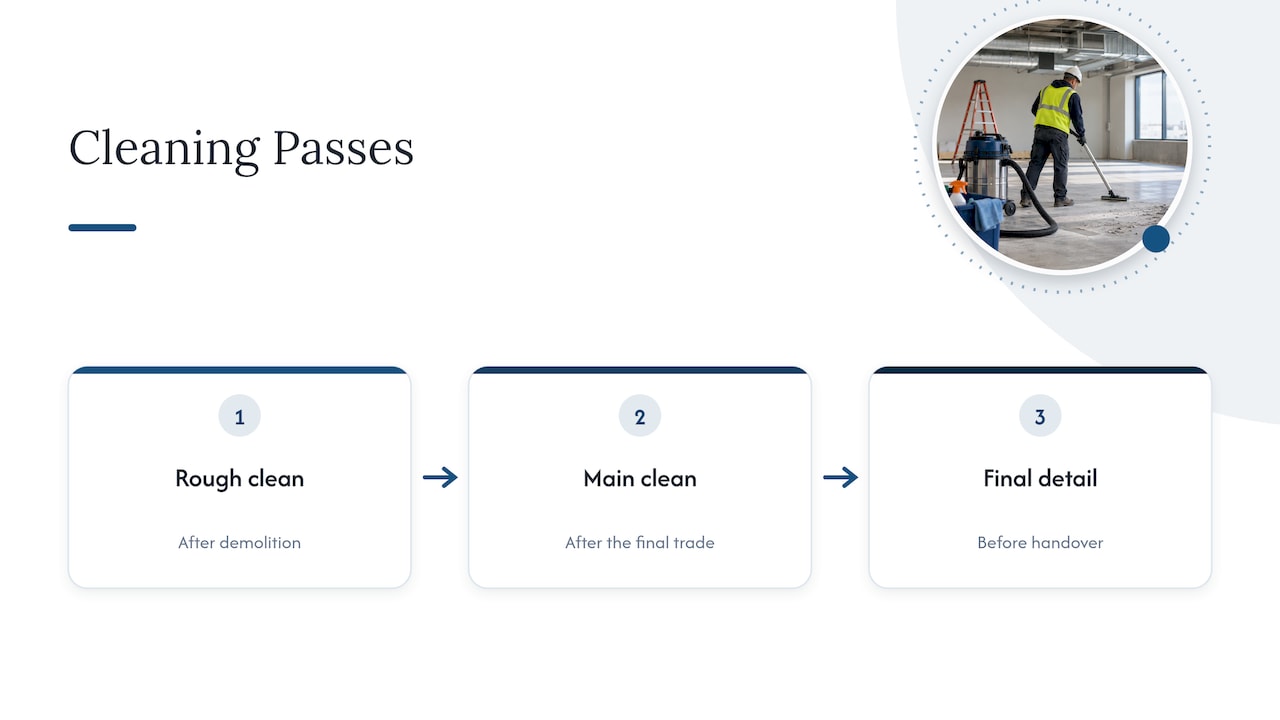
We use a three-pass logic tied to trade handovers on phased projects, described in our guide to office renovation cleaning in Calgary. The same thinking applies to an HVAC job: rough clean after demolition, a main clean after the final trade, and a final detail clean before handover.
Methods that keep dust from spreading
Dry sweeping and compressed air are the fastest ways to put fine dust back into the air. Guidance from official Canadian sources points the other way.
- Filtered vacuums. Alberta Infrastructure’s Green Guide says caretaking vacuums should be canister or backpack style with three-stage filtration that captures at least 96% of 0.3 micron particles. That is a government facility standard, and it is a sensible benchmark for any commercial job.
- Damp wiping. Health Canada’s guidance for office buildings recommends that dusting and mopping use damp or wet methods with lint-free cloths to reduce dust generation.
- Timing and isolation. The same guidance advises scheduling contaminant-generating cleaning at times that limit occupant exposure and isolating work areas to stop contamination spreading. In practice that means evenings, weekends and barriers at doors and ceiling openings.
- HEPA air cleaners as a support. Health Canada’s draft guidance says HEPA air cleaners can reduce some contaminants but should accompany source reduction and improved ventilation, and should not produce ozone. They do not replace cleaning.
Good dust control also helps the crew: a clean, well-organized workspace is safer to move through. Our overview of commercial cleaning and workplace safety explains how we think about it.
Surface readiness and manufacturer restrictions
Before a cloth touches new equipment, confirm three things in writing with the mechanical contractor.
- Is the surface ready? Paint, sealant, adhesive and gasket compounds may still be curing. Wiping them early smears dust into the finish.
- What do the manufacturers say? Grilles, diffusers, coils, painted louvres, sensors and controls often have care and cleaning instructions. If the manufacturer restricts liquids, solvents or abrasion on a part, we clean around it or dry-clean it only.
- Who is responsible for what? Anything inside the equipment envelope, including coils and fan sections, goes back to the mechanical contractor or the manufacturer’s service channel.
This step protects warranties as much as surfaces. A short sign-off sheet that lists “cleaned”, “cleaned dry only” and “not touched” for each item removes arguments later.
Heading to reopening: what the building manager checks
Health Canada’s guidance sets out what has to happen before a space is reoccupied: all construction materials and debris removed, the area cleaned appropriately for the contaminants present, and all mechanical systems confirmed clean, balanced and operational. Surface cleaning supports the first two. The third belongs to the mechanical, balancing and commissioning trades, and the building manager should have their sign-off before opening the doors.
A practical handover checklist:
- Walk each area with a light held low and across the surface, which shows dust that overhead light hides.
- Wipe-test a few surfaces at ceiling-grid, grille and shelf height with a clean white cloth.
- Check corners, tracks, door frames and the tops of equipment housings.
- Confirm plant access routes and the freight elevator are clean and any protection has been removed.
- Collect the commissioning and balancing reports from the right trades.
- Have the landlord or their representative inspect. In Calgary office towers, it is typical for the landlord to inspect pre-occupancy cleaning before the premises are accepted.
The requirements differ by building, so see our guide to commercial occupancy cleaning requirements in Calgary.
Planning the cleaning around the HVAC schedule
Most rework comes from scheduling. If the cleaning is booked for the last day, any trade that runs over pushes the cleaning into the opening date, and the final clean gets squeezed. Build the cleaning into the construction schedule early, particularly when an upgrade sits inside a wider fit-out. A renovation planned with a commercial renovation contractor in Calgary should show cleaning milestones next to the mechanical ones.
Questions to settle at the pre-construction meeting:
- Which areas are cleaned between phases and which only at the end?
- Who removes protection from equipment, and when?
- Who confirms that the surfaces are ready for wiping?
- How long is the settling window before the final clean?
- Which sign-offs does the building manager need before reopening?
If the HVAC upgrade is part of a tenant improvement, our guide to tenant improvement cleaning in Calgary occupied buildings covers coordination with people still working in the space.
Our perspective
We have been cleaning commercial projects since 2012, and the pattern on mechanical jobs is consistent: the dust is never only where the equipment went in. It is in the ceiling grid, on the fixtures, along the corridor the unit was rolled down, and on the grille faces that everybody forgets until the first complaint.
Our approach is to write the scope with the contractor and the building manager before work starts. We agree what we clean, what we leave to the HVAC trades, and which surfaces need a manufacturer’s approval. We are certified and insured, we use advanced equipment, and we build a customized plan for each facility, because a tower floor and a single-storey warehouse office do not behave the same way.
We will not clean inside HVAC systems, and we say so up front. Surface cleaning done well makes the commissioning team’s job easier, and a clear handover makes the building manager’s job easier.
Jack
Book the cleaning with the project
Eshine is a privately owned commercial cleaning company serving Calgary. Our post-construction cleaning is planned around your trades, with customized plans, flexible scheduling and ongoing quality control. After more than 700 projects, 85% of our clients come back to us. If you have an upgrade scheduled, send us the mechanical schedule and your landlord’s cleaning requirements, and we will propose phases that fit.
See our post-construction cleaning services or read the Calgary post-construction cleaning guide for what a project normally involves.
FAQ
Does post-construction cleaning include cleaning the ductwork?
No. Surface cleaning covers the accessible building surfaces: ceilings, fixtures, floors and the faces of grilles and diffusers. Duct cleaning is a separate specialist scope, and the NRC has reported that duct-cleaning activity can raise airborne particles, so it should be planned deliberately and sequenced with the surface clean.
When should the final clean happen after HVAC work?
After the last trade finishes working above the ceiling and in the space, and after the settling window you agreed. Cleaning before the balancing and commissioning visits risks repeating the work, because access panels are opened again and ceiling tiles are lifted.
Can the building stay open while the cleaning is carried out?
Often, with planning. Health Canada guidance advises scheduling dust-generating cleaning to limit occupant exposure and isolating work areas. Off-hours work, barriers and filtered equipment make that possible in an occupied building.
Who signs off the space before reopening?
The building manager or landlord’s representative signs off the cleaning. The mechanical, balancing and commissioning trades confirm that the systems are clean, balanced and operational. You need both before the space returns to normal use.
Sources
- Brookfield Place Calgary Tenant Design and Construction Manual (2022)
- Health Canada, Guidance for Improving Indoor Air Quality in Office Buildings
- Health Canada, draft guidance on indoor air quality in office buildings
- Alberta Infrastructure, Green Guide
- NRC, testing effectiveness of duct cleaning (2012)
- NRC, is ventilation duct cleaning useful? (2010)


