


Cleaning Contractor Transition Plan for Calgary Businesses
A good cleaning contractor transition plan covers six things: the outgoing contractor’s final visit, who owns the supplies and equipment on site, a baseline clean by the incoming team, a controlled handover of keys and access, a decision on overlap or gaps, and a review in the first week. Do these in order, put them in writing, and the change happens without a missed night, a lost key or a surprise for your staff.
This guide is for Calgary business owners and property managers who have already decided to change providers. It does not repeat why you might switch or how to pick a company. It covers the practical part: what happens between the last visit of one team and the first full week of the next.
TL;DR
- Treat the handover as a project with one owner on your side, a written checklist and a target start date for the new team.
- Get every key, fob, alarm code and badge accounted for in a signed log before the outgoing team’s last visit.
- Have the incoming contractor do a baseline clean, so you start from a known standard instead of inheriting old problems.
- Decide in advance whether you want a short overlap or a planned gap, and who covers washrooms and garbage in between.
- Hold a review in the first week, then again at the end of the first month, with a clear way to log and correct missed tasks.
Table of Contents
- Start with a transition owner and a calendar
- The outgoing contractor’s final visit
- Keys, codes and access: control the handover
- Supplies, equipment and who owns what
- The baseline clean: reset the standard
- Overlap or gap: choose on purpose
- Walkthrough: write the scope before day one
- First-week priorities
- What staff and tenants need to know
- Our perspective on transitions
- Planning your Calgary handover with Eshine
- FAQ
- Sources
Start with a transition owner and a calendar
Most handover problems come from nobody owning the whole process. The outgoing team assumes you collected the keys. The incoming team assumes the building is ready. Your staff assume someone told the front desk.
Name one person, usually the office manager, property manager or operations lead, as the transition owner. That person keeps the checklist, talks to both contractors and signs off each step.
Then build a simple calendar working backward from the new team’s first scheduled visit:
| Timing | What happens |
|---|---|
| Before anything else | Read the current agreement for term, renewal, notice and what must happen at exit |
| 2 to 4 weeks before the start | Walkthrough with the incoming contractor, written scope, access plan agreed |
| Week before the start | Outgoing final visit scheduled, key and inventory log prepared |
| Day of the final visit | Walk the site, collect keys, record supplies and equipment |
| First visit of the new team | Baseline clean, access confirmed, priorities set |
| End of the first week | Review with a short written list of what to fix |
| End of the first month | Second review, adjust scope or schedule |
The exact spacing depends on your contract and your building. Your existing agreement sets the notice and exit terms, so read it before you set a date. Terms such as automatic renewal, termination for convenience, cure periods and early-termination fees are the usual items to check, and a lawyer can confirm how they apply to your situation. Eshine does not set those terms for your current contractor, so we stay out of guessing at them.
The outgoing contractor’s final visit
The last visit is easy to neglect because the relationship is ending. It is also your best chance to close out the old arrangement cleanly.
What to ask for
Send a short written note confirming the date of the final visit and what you expect from it. Reasonable items include:
- The regular scope completed to the usual standard, including washrooms, kitchens and garbage.
- Return of every key, fob, access card and alarm code that the contractor holds.
- A list of any staff names that had access, so you can remove them from your systems.
- Any notes on the building the contractor wants to pass on, such as problem spots or areas that were off limits.
If periodic work was part of the old arrangement (floor care, carpet cleaning or high dusting on a cycle), ask when each task was last done. That tells the new team where to start and tells you what you were actually getting.
Walk the site together
Walk the premises with the outgoing supervisor if you can, and photograph the condition of the building. Dated photos of floors, washrooms, entrance areas and storage rooms are a simple record for the handover. If a dispute about damage or missed work comes up later, you have a reference point.
If you manage a multi-tenant building, tell tenants the date of the change and who to contact. Our multi-tenant cleaning in Calgary page explains how we think about shared spaces across tenants.
Keys, codes and access: control the handover
Security is the part of a transition people regret most when it goes wrong. A cleaning team often has the widest after-hours access in the building.
Build an access log
Before the final visit, list every access item the outgoing contractor has. For each item, note the type, the number or code, who holds it and the return date. Sign the log when items come back.
Then reset what can be reset. Change alarm codes, deactivate cards issued to the outgoing team and update any lockbox codes. Do this after the final visit, not before, so the old team can finish the job.
Issue access to the new team on purpose
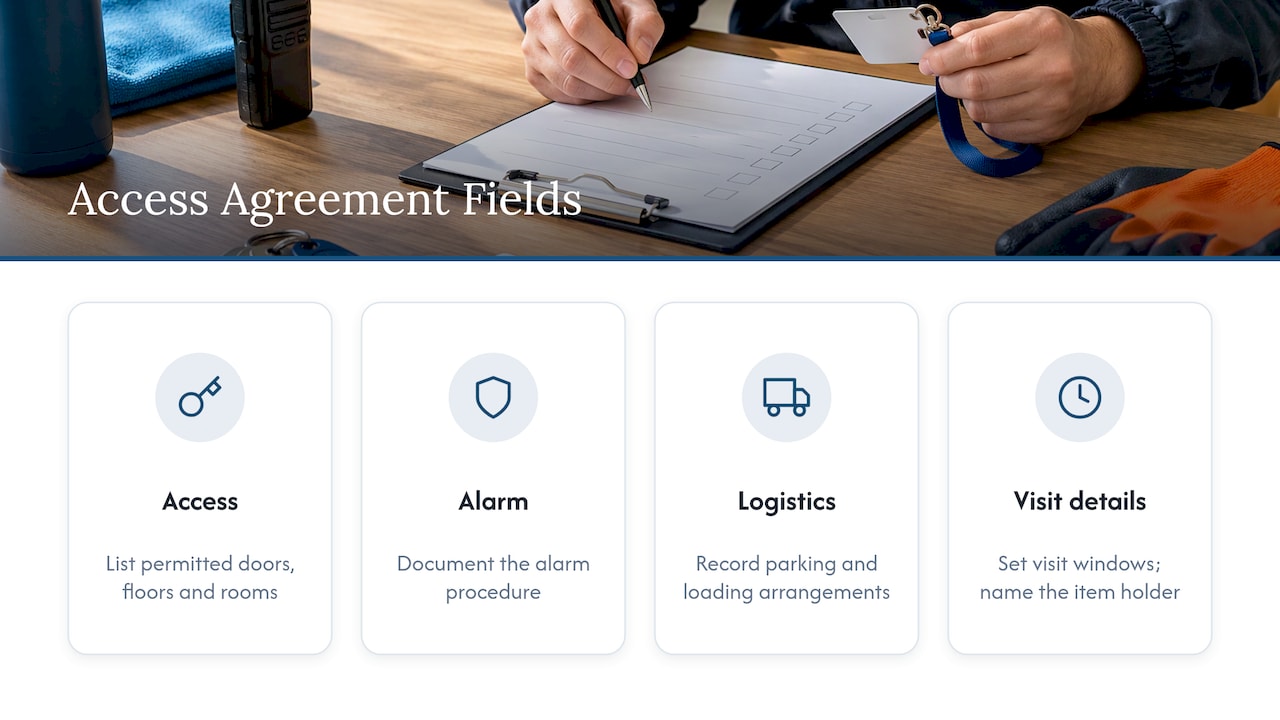
Give the incoming contractor only what the scope needs. Write down which doors, floors and rooms they enter, the alarm procedure, parking and loading arrangements, and the time window for each visit. Record who at the contractor holds each item. Put it in a one-page access agreement that the transition owner and the contractor’s supervisor both sign.
If some rooms are restricted (server rooms, file rooms, executive offices, labs), mark them on a floor plan and state whether they are in scope at all. Our guide to preparing your Calgary office for professional cleaning covers clearing surfaces and setting expectations with staff before the first visit.
Supplies, equipment and who owns what
Inventory ownership is where friction hides. Is the vacuum in the janitor closet yours or the old contractor’s? Are the paper products, liners and hand soap your purchase or part of their pricing? The answer depends on your agreement and your invoices, so confirm it in writing instead of assuming.
Before the final visit, make three lists:
- Your property: items you bought, such as dispensers, carts, supplies and any equipment on your asset list.
- Contractor property: machines, chemicals, tools and carts the outgoing team brought and will take away.
- Shared or unclear: anything you cannot place. Settle these with the outgoing contractor before they leave.
Count consumables on the final day and note the quantities. That gives the incoming team an accurate starting stock, and it shows you what you are paying for under the new scope.
Chemicals and safety documents
When products change hands, so does your safety paperwork. In Alberta, WHMIS 2022 is the only valid version since the transition period ended in December 2025, and employers must keep a current safety data sheet (SDS) for every hazardous product used at the work site, keep it accessible and train workers who work with or near those products, according to the Government of Alberta’s WHMIS guide for workers.
In practice, that means:
- Remove or return the old contractor’s products, and take their SDSs out of your binder or folder.
- Ask the incoming contractor for the list of products they will use on your site and the matching SDSs before the first visit.
- Confirm where the SDSs are kept and that your staff know the location.
Site-specific hazards and cooperation between the parties on a work site also matter. The Government of Alberta’s occupational health and safety starter kit lists the topics employers should address. Our own overview of commercial cleaning and workplace safety explains how that fits into daily cleaning routines.
Insurance and WCB paperwork
Ask the new contractor for proof of insurance and for a WCB-Alberta clearance letter. WCB-Alberta advises requesting a clearance letter before a contractor starts, since it confirms who is covered, the industry and whether the account is in good standing, and says you can make coverage a condition of the contract (WCB-Alberta on contractors and subcontractors). File both documents with the transition checklist.
The baseline clean: reset the standard
The baseline clean is the incoming team’s first, more thorough visit. Its purpose is to bring the building to a defined starting point so that regular service can maintain it, instead of slowly catching up.
Why it helps
Without a baseline, the new contractor works around whatever the previous team left behind: dust on ledges, soiled grout, buildup along baseboards, marks on glass. Either those problems are never fixed, or they surface as complaints in week three. A baseline clean sets a clear line and makes later quality checks fair for everyone.
A baseline usually goes beyond the routine scope: high and low dusting, edges and corners, washroom fixtures, entrance areas, hard floors and interior glass. The right mix depends on your space and what the walkthrough turns up. We write the scope for each facility, not from a template.
When to go further
Some transitions justify a deeper clean than a standard baseline:
- After renovation or a tenant fit-up. Construction dust travels into ceilings, vents and corners that regular cleaning never reaches. That is the job of post-construction cleaning, and it is separate from the maintenance contract. Our final cleaning before move-in page explains what that stage covers.
- After a long run of missed work. If tasks were skipped for months, the building needs a reset before routine service can hold it. Our list of commonly missed office cleaning tasks in Calgary is a useful checklist for spotting where that has happened.
- Before an occupancy or inspection date. If the building faces an inspection or a new tenant, see our notes on commercial occupancy cleaning requirements in Calgary.
Ask the incoming contractor to quote the baseline clean as its own line, separate from the recurring price, so you can compare it fairly and so you do not pay for it indefinitely.
Overlap or gap: choose on purpose
Your calendar will land on one of three patterns. Pick the one that suits your building and risk tolerance.
| Pattern | How it works | Best for | Watch out for |
|---|---|---|---|
| Clean cut | Old team’s last visit, new team’s first visit the next scheduled night | Single-tenant offices with a stable routine | A missed night if dates slip |
| Short overlap | Both teams work for a few days, with the new team running its baseline | Larger sites, shared buildings, high-traffic areas | Double billing and crowded access, so define scope for each team |
| Planned gap | A few days with no routine service while the baseline is scheduled | Sites needing a deep reset or a closed period | Washrooms, garbage and spills still need a plan |
If you accept a gap, decide who handles garbage, washroom restocking and visible spills. A staff rota for a few days is manageable. An unplanned gap of two weeks is not.
Whichever pattern you pick, write the exact first visit date and time into the agreement with the new contractor. Ask for the first visit to be confirmed in writing 48 hours ahead.
If you are comparing how scopes and schedules are written, our guide on how to compare commercial cleaning options in Calgary walks through scope, frequency and pricing structure.
Walkthrough: write the scope before day one
A transition goes best when the new scope comes from a real walkthrough of the space rather than a phone estimate. Walk each room with the contractor’s representative: washrooms, staff kitchens, work areas, entrances, stairwells, shared spaces and storage. Mark restricted areas and agree on floor areas. Checklists from the construction trades, such as this commercial project checklist for contractors, show how documenting rooms and conditions up front keeps everyone working from the same facts.
The written scope should state:
- Which tasks happen at each visit, weekly and monthly, and which are periodic.
- Visit days and time windows, including how statutory holidays are handled.
- What the recurring price includes and which items are priced separately.
- How you will report a missed task and how fast the contractor responds.
If you change contractors mid-year, the paperwork you built during the old contract is useful too. Our note on commercial cleaning documentation in Calgary explains which records are worth keeping.
First-week priorities
The first week is for catching and fixing, not for judging. Set clear priorities for the new team and tell your staff what to expect.
Day one to day three
- Confirm the new team can enter, disarm and re-arm the alarm and lock up as agreed.
- Complete the baseline clean and walk the result with the supervisor.
- Stock washrooms and kitchens and confirm who orders supplies from now on.
- Post the contact details of the supervisor and your transition owner where staff can find them.
Day four to day seven
- Check the high-visibility spots first: reception, washrooms, boardroom, kitchen and entrance.
- Log anything missed, with photos and times, in one shared document.
- Hold a short review: what went well, what needs correcting, what changes in the schedule.
Agree on a method for reporting missed tasks and a timeline for the contractor to correct them. A shared log and a named contact are enough for most offices.
The second review at the end of the first month is where you look at patterns rather than single events. Are the same areas being missed? Is the schedule right for the way your team actually uses the space? That conversation is easier when the baseline is documented.
What staff and tenants need to know
A short message before the change prevents most of the questions you would otherwise field. Send it a week ahead and cover:
- The date of the first visit by the new team.
- Who to contact about a missed task or concern.
- Any change to when staff should clear desks or leave areas accessible.
- Any change in where personal items, supplies or equipment are kept.
Staff who do not know a new team is coming often report them as unfamiliar people in the building. A heads-up avoids that and keeps the front desk informed.
Our perspective on transitions
A handover is where a cleaning relationship either starts well or starts with a list of grievances. In our experience, the buildings that change providers smoothly have three things in common: one person who owns the process, a written scope that came from a real walkthrough, and a first clean that resets the standard.
We build each plan around the facility in front of us, with flexible scheduling and ongoing quality control, because no two Calgary buildings use space the same way. Our team is certified and insured, and we use advanced equipment so that the first visit and the fiftieth meet the same standard. Eshine is privately owned, not a franchise, so the person who walks your site with you is part of the company that answers for the work.
If you are mid-change right now, start with the access log and the baseline scope. Those two items prevent most of the problems we hear about.
Jack
Planning your Calgary handover with Eshine
Eshine Cleaning Services is a privately owned commercial cleaning company serving Calgary businesses, with customized cleaning plans for offices, new builds and renovated spaces. Since 2012 we have completed more than 700 projects, and 85% of our clients come back.
If you are changing providers, we can walk your premises, write the scope around your space and schedule a baseline clean ahead of regular service. For a look at what we do in Calgary, visit Eshine Cleaning Services.
To see how we handle offices, our page on professional office cleaning for Calgary law and accounting firms shows the approach for client-facing workplaces.
A final planning aid: contract-ready plans from other industries show how a written handover is laid out in advance. A property manager planning a contractor handover can borrow the same discipline of naming responsibilities, triggers and contacts, and then fit it to cleaning.
FAQ
How long should a cleaning contractor transition take?
Plan on two to four weeks from the walkthrough to the first full week of service, longer if your current agreement has a notice period. The timeline depends on your contract and your building, so read the agreement first and set the new start date to fit it.
Should the old and new contractors work at the same time?
A short overlap suits larger or shared buildings, since the new team can run its baseline while the old team still covers the routine. A clean cut works for a single-tenant office with a simple routine. Whichever you pick, define the scope for each team in writing so you do not pay twice for the same task.
What should I get back from the outgoing contractor?
Collect every key, fob, access card and alarm code, and sign a log as items return. Settle which supplies and equipment belong to you and which leave with the contractor. Then reset alarm codes and deactivate cards the old team held.
What paperwork should the new contractor provide?
Ask for proof of insurance, a WCB-Alberta clearance letter, a list of the products they will use and the safety data sheets for each. Keep these with your transition checklist and put the SDSs where your staff can reach them.
When should I review the new contractor’s work?
Hold a first review at the end of week one and a second at the end of the first month. Use one shared log for missed tasks, with photos and dates, so corrections are specific and quick.
Sources
- WHMIS information for workers, Government of Alberta (December 2025)
- Occupational health and safety starter kit, Government of Alberta (June 2026)
- Coverage for contractors and subcontractors, WCB-Alberta
- Commercial project checklist for contractors in 2026


