


Post-Construction Cleaning Before Equipment Installation in Winnipeg
Clean the space before the equipment goes in, not after. Once fixed equipment is bolted down, the floor beneath it, the wall behind it and the service gap around it can’t be cleaned properly again without moving it. In Winnipeg, where a project runs through dry winter air, tracked-in grit and tight handover dates, a short cleaning window placed just before delivery protects the equipment, the finishes and the schedule.
This guide is for project managers, building managers and owners. It covers the order of work, a pre-delivery scope map, cleaning behind future equipment locations, protecting finished areas, who handles packaging, and a touch-up visit after installation. It also draws a clear line around what building cleaning covers and what belongs to equipment installers, commissioning agents and hazardous-material specialists.
TL;DR
- Schedule a dedicated cleaning window after trades finish in the equipment zone and before delivery. Those surfaces become unreachable once equipment is set.
- Work top to bottom, dry before wet, and use HEPA vacuums and damp methods. Never use compressed air or dry sweeping on construction dust.
- Build a scope map room by room: floors, walls, ceilings, service areas and the footprint of every future piece of equipment.
- Agree in writing who removes packaging, who protects finished floors and who cleans after the installers leave.
- Book a touch-up visit after installation for the dust and debris that installation itself creates.
Table of Contents
- Why the pre-delivery window matters
- Where cleaning fits in the sequence
- Build a pre-delivery scope map
- Cleaning behind and beneath future equipment locations
- Protecting completed areas during delivery
- Who handles packaging and waste
- What cleaning covers, and what it doesn’t
- The touch-up visit after installation
- How cleaning and installation teams avoid recontamination
- Our perspective
- Plan your pre-installation clean with Eshine
- FAQ
- Sources
Why the pre-delivery window matters
Equipment installation changes what can be reached. A rack, a counter line, a server cabinet, a fixed workstation bank or a heavy retail fixture covers a patch of floor and often a strip of wall. Whatever dust, adhesive residue, drywall compound or screw debris sits there on delivery day stays there.
That matters for three reasons.
- Dust migrates. Fine construction dust settles on horizontal surfaces and gets pulled into vents and cabinets. Health Canada identifies renovation activities and surfaces that are not regularly cleaned as common indoor sources of fine particles (PM2.5), which can enter the lungs.
- Rework costs more than one visit. If equipment must be shifted to clean under it, you pay for installers, possibly a re-inspection, and the delay.
- Handover standards are visual. An owner or tenant who signs off sees no visible dust and residue-free surfaces. Trapped debris becomes a deficiency item after the installers are gone.
If you want the general stages of post-construction cleaning first, our guide to what post-construction cleaning includes covers them. This article is about timing and scope around fixed equipment.
Where cleaning fits in the sequence
A typical commercial fit-out reaches a point where the building trades are done and the equipment trades are about to start. Cleaning belongs in that gap.
| Stage | What is happening | Cleaning role |
|---|---|---|
| Building trades finishing | Drywall, paint, ceiling grid, flooring, millwork | Trade-level tidy-up only, kept by each trade |
| Trades complete in equipment zone | Written confirmation from the site lead | Pre-delivery clean of accessible surfaces |
| Protection and staging | Floor protection down, delivery route marked | Protect finished areas, confirm clear routes |
| Equipment delivery and installation | Packaging, anchoring, connections | Packaging removal agreed per contract |
| Commissioning and testing | Specialists start and test equipment | Not a cleaning task |
| Post-installation touch-up | Installer debris and fingerprints | Touch-up visit and final walkthrough |
The most common sequencing error is calling the cleaners before trades have actually finished. Dust from a late sanding or cutting job lands on surfaces you just cleaned. A written trade completion confirmation for the area, before cleaning begins, is a rule worth adopting. NeatScore’s checklist lists it among six sequencing rules, alongside top to bottom, dry before wet, back to front, wet areas before dry areas and glass last.
The order inside each room
Within each room the cleaning order protects work already done.
- High to low. The IERHA construction clean checklist specifies that cleaning is sequenced from higher to lower elevations so dust isn’t aerosolized or brushed onto surfaces already cleaned.
- Dry before wet. Remove loose dust with HEPA vacuuming, then damp wipe, then damp mop.
- Back to front. Work toward the exit so nobody walks across finished floor.
- Floors last in each area. Anything that falls during overhead and wall work is picked up by the final floor pass.
That checklist comes from a healthcare setting, so its standard is strict. Many commercial projects don’t need it all, but the logic of its order applies to any space where equipment is about to go in.
Build a pre-delivery scope map
A scope map is a one-page list, by room or zone, of what gets cleaned, by whom and when. It removes the guessing that causes gaps between trades. Walk the space with the floor plan and the equipment layout, and mark each zone.
| Zone | Surfaces to clean before delivery | Method | Notes |
|---|---|---|---|
| Future equipment footprints | Floor, adjacent wall base, anchor points | HEPA vacuum, then damp wipe or mop | Last chance to reach this floor |
| Wall faces behind equipment | Walls, outlets, wall-mounted blanks | Dry or damp cloth as the surface allows | Check adhesives and paint residue |
| Overhead | Ceiling underside, beams, top of grid, ledges | HEPA vacuum | Done before floors |
| Ductwork and piping exposed | All sides of accessible duct, pipe runs, diffusers | Damp cloth | Don’t disturb insulation or fittings |
| Electrical conduit, junction boxes, cable tray | Exterior surfaces | Dry cloth | No liquids near electrical |
| Service areas | Mechanical room floors, utility corridors, loading routes | HEPA vacuum, damp mop | Delivery routes need to be clean and clear |
| Glass and mirrors | Both sides | Last pass | Done after all dust-making work |
The cleaning methods per surface follow the IERHA checklist, which calls for HEPA vacuuming on ceiling undersides, beams and ledges, damp cloths on ductwork, piping and diffusers, and dry cloths on electrical conduit, junction boxes and cable tray. Use it as a reference point, not a rule for every building.
Questions to settle on the map
- Which areas will be inaccessible once equipment lands? Those go first.
- Are any surfaces still waiting on a trade (touch-up paint, sealant, caulking)? Mark them as not ready.
- Where do deliveries enter, and which floors do they cross?
- Who holds keys and access, and when is the building quiet?
- Does anything in the zone have an existing manufacturer cleaning instruction that cleaners must follow?
Our team builds a scope map like this with the project manager before the first visit, so the plan fits the facility rather than a template.
Cleaning behind and beneath future equipment locations
This is the part of the job that can’t be redone. A few practices help.
Use the layout drawing, not memory. Mark equipment footprints and clearance zones on the floor with tape or chalk if the installers haven’t already. Clean the full footprint plus a margin, since equipment rarely lands exactly where drawn.
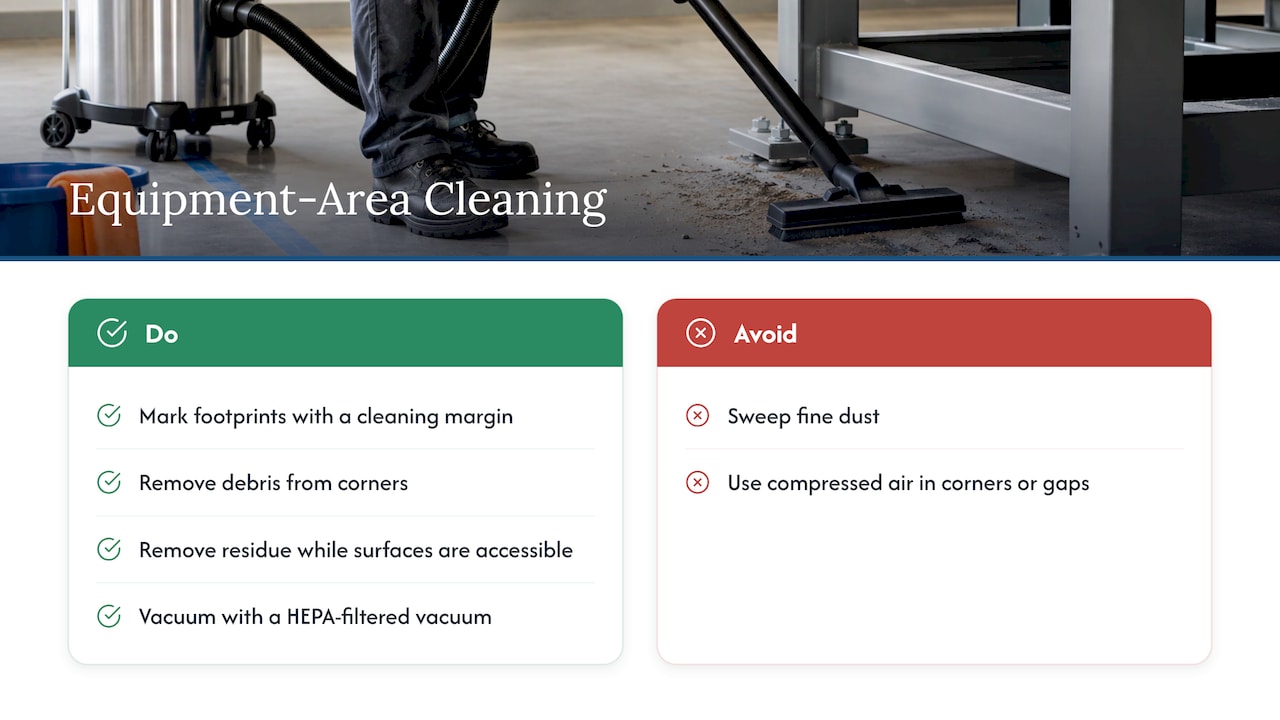
Remove the debris that hides in corners. Wall bases, floor-wall junctions, inside corners and the space behind pipe chases collect drywall dust, screws, tape ends and cut-offs. These are what end up under a cabinet.
Tackle residue while it is accessible. Paint drips, adhesive and sealant smears on floors and wall bases are much harder to remove once a heavy unit sits there. Some residue needs a specific method that suits the surface, so protect finished flooring before using anything stronger than a damp cloth.
Vacuum with HEPA, don’t sweep. Health Canada recommends vacuuming with a HEPA-filtered vacuum rather than sweeping to control dust. Sweeping lifts fine particles that settle again on the surfaces you just finished.
No compressed air. Using compressed air to blow dust from corners or gaps spreads it. NeatScore notes that CCOHS guidance describes compressed air as forcing contaminants into the air and as restricted or prohibited in many jurisdictions. For suspected asbestos-containing material specifically, WCB Manitoba’s Asbestos Management guide says compressed air must not be used to clean up.
Protect the air handling system
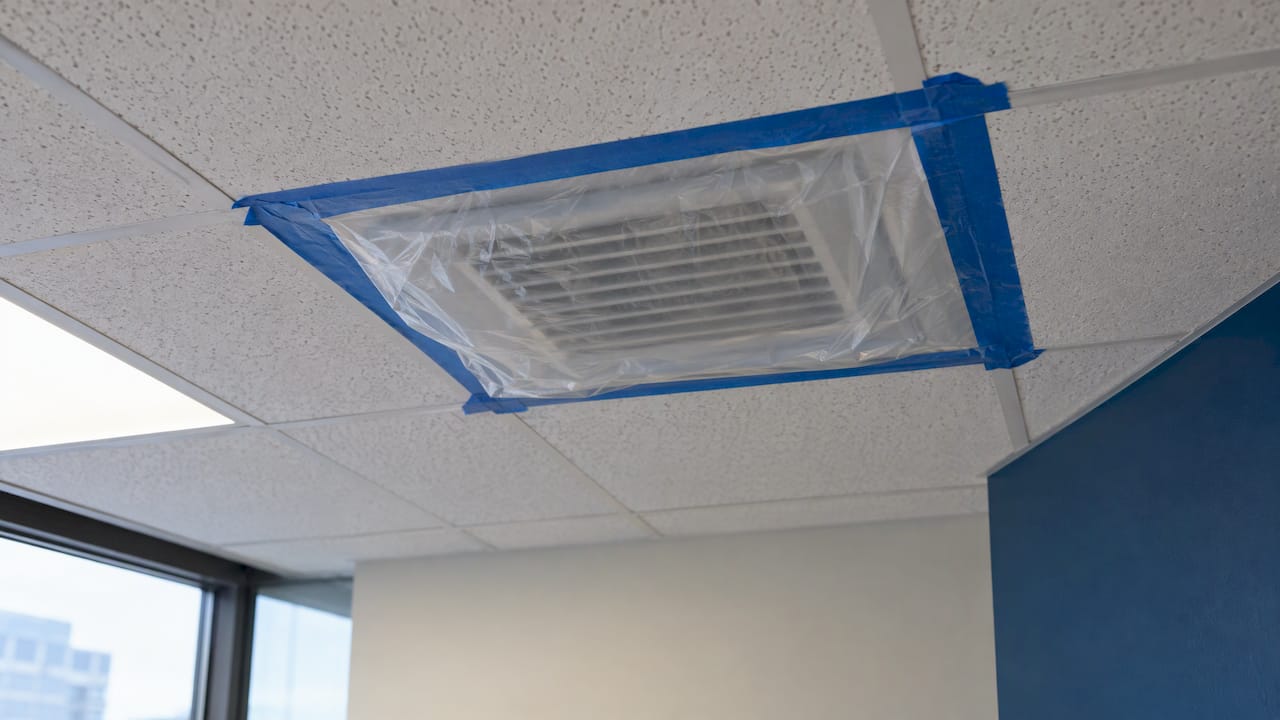
If the building’s air handling is running while you clean, dust can travel into it. Health Canada’s office-building guidance recommends using barriers to limit dust entering the air handling system and consulting an HVAC professional before renovation work. Agree with your mechanical contractor on diffuser covers, return protection and when filters are changed.
Protecting completed areas during delivery
Finished floors, walls and corners take the most damage between the end of cleaning and the end of installation. Protection is part of the plan, not an afterthought.
- Define the delivery route. One route, marked, from the dock or entrance to the equipment location. Everything else stays closed.
- Protect floors on the route. Use protection suited to the floor type and to the loads, such as wheeled carts or pallet jacks. A thin film won’t carry a loaded pallet jack.
- Guard corners and door frames. Corner guards and frame wraps are cheap compared with repainting.
- Control access to cleaned rooms. Close doors, post a sign and, where useful, set a footwear rule. Winter slush, salt and sand tracked from the parking area are a real issue in Winnipeg. Our winter post-construction cleaning guide covers how cold-season conditions change the plan.
- Record the condition. Photograph cleaned zones before delivery. It gives everyone the same baseline if a question arises later.
- Keep protection in place until the end. Remove covers only at the final walkthrough, otherwise you clean twice.
The cleaned zone is also not a staging area. Tools, cartons and spare parts left in it return it to a dirty site within a day.
Who handles packaging and waste
Packaging is where responsibility most often goes missing. Equipment arrives in cartons, crates, foam, strapping and pallets. If nobody owns it, it sits in the cleaned area.
Decide before delivery:
| Item | Typical owner | Agree in writing |
|---|---|---|
| Crates, pallets and strapping | Installer or equipment supplier | Removal off site, not into the building’s bins |
| Foam, plastic wrap and cartons | Installer unless otherwise agreed | Daily removal from the work zone |
| Installer offcuts, screws, wire ends | Installer | Clean as they work |
| Floor protection removal | General contractor or project manager | When and by whom |
| Dumpsters and disposal | General contractor | Capacity for packaging volume |
| Final debris pickup and surface cleaning | Cleaning contractor | Included in the touch-up visit |
The general principle is that whoever creates the waste removes it, and the cleaning contractor handles surface cleaning afterward. If you want cleaners to also haul packaging, say so in the scope and allow for the time, since it changes the visit length and disposal arrangements.
What cleaning covers, and what it doesn’t
A clear boundary prevents disputes. Building surface cleaning is one scope. Other work belongs to specialists.
Cleaning of accessible building surfaces includes floors, walls, ceilings, ledges, glass, frames, doors, exposed ducts and piping exteriors, and the equipment footprint before it is covered.
Not part of building cleaning:
- Machinery and equipment cleaning. Internal cleaning of machines, process lines, ovens or electronics follows the manufacturer’s instructions and is handled by the installer or a qualified technician.
- Commissioning, start-up and testing. Running, calibrating and certifying equipment belongs to installers and commissioning agents. Cleaners should not operate equipment.
- Hazardous-material work. If materials such as asbestos may be present, stop and call a qualified specialist. WCB Manitoba states that only wet wiping or specialized HEPA vacuuming should be used to clean surfaces that may be contaminated with asbestos, since ordinary vacuums can let fibres pass through and spread. Determining what is present and how to handle it is not a general cleaning task.
- Air handling work. Duct cleaning, balancing and filter replacement belong to the mechanical contractor.
Putting these exclusions in the scope map protects everyone. The cleaning crew knows what to leave alone, and the project manager knows who owns each remaining task.
The touch-up visit after installation
Even a careful installation leaves traces: fine dust from drilling and anchoring, fingerprints on walls and glass, small debris around bases, scuffs and footprints on floors. A touch-up visit sweeps these up without redoing the whole building.
Plan it as a short, targeted visit:
- Timing. Book it for the day after installers finish and commissioning has reached a point where the area is no longer being worked in. Cleaning during testing invites interruptions.
- Scope. Equipment exteriors that are safe to wipe, per the manufacturer, floors around and between installed units, glass, door hardware, wall faces and any area where protection was removed.
- Method. Same discipline as before: high to low, HEPA vacuum, damp wipe.
- Walkthrough. Walk the space with the project manager or owner against the scope map.
What a good handover looks like
Health Canada’s office-building guidance says that before reoccupying a renovated space, all construction materials and debris should be removed and the area adequately cleaned, with systems functional and air handling confirmed clean, balanced and operational. As a practical measure, NeatScore describes a handover standard of no visible dust on any surface, no adhesive or paint residue, clean glass, undamaged floors, protective coverings removed and the site clear of cleaning equipment and waste. Use that as your walkthrough list.
For ongoing upkeep after handover, Health Canada recommends proactive housekeeping with a HEPA-filter vacuum system and MERV 13 or higher filters where possible. A recurring schedule keeps the benefit of the work you just did.
How cleaning and installation teams avoid recontamination
Most delays come from handoffs, not from the cleaning itself. These habits keep them smooth.
- Hold one short coordination meeting with the project manager, the cleaning contractor and the installer lead before delivery. Cover access, hours, delivery route, packaging and the touch-up date.
- Share the equipment layout with cleaners so they clean the right footprints.
- Give a single point of contact on site who can confirm trades are complete.
- Sequence by zone, not by building. Clean and release one zone at a time, then protect it, so installers can start where cleaning has finished.
- Keep a log. Date, zone, status: ready, cleaned, protected, installed, touched up.
- Plan for different building types. The same logic applies in different sites. Our warehouse and distribution centre guide looks at large floors and loading areas, and our commercial developments guide covers larger multi-tenant projects.
For safety questions on site, our five safety checks for construction cleaners is a quick reference for facility managers.
Our perspective
We have been cleaning commercial spaces in Winnipeg since 2012, across more than 700 projects. The pattern we see most is simple: the cleaning gets booked at the end, after the equipment is in, when the hardest places to clean are already covered.
Our view is that the pre-delivery clean deserves its own line in the schedule. It is a small slice of the total project and it removes problems that are expensive later. We build a plan around the facility, the equipment layout and the access the project allows, which is why we write a scope map with the project manager rather than quote from a template.
We are certified and insured, we use advanced equipment, and we are a privately owned company, not a franchise, so the people you speak to at the start are the people accountable at handover. Ask us to separate surface cleaning from the work that belongs to installers and specialists. A clear scope is the best way to protect your schedule.
Jack
Plan your pre-installation clean with Eshine
If you have equipment arriving at a Winnipeg commercial space, we can help you place the cleaning where it counts: a pre-delivery clean of accessible surfaces, a protection plan and a post-installation touch-up, scheduled around your trades. Our post-construction cleaning is customized to each facility, with flexible scheduling and ongoing quality control. See our commercial cleaning services or contact us with your floor plan and installation dates.
If you are still deciding on a contractor, our guide on how to hire a post-construction cleaning company in Winnipeg lists what to ask. For the basics, read what post-construction cleaning is and our practical tips for Winnipeg commercial properties.
FAQ
When should post-construction cleaning happen relative to equipment delivery?
After all trades in the area have confirmed completion and before the equipment arrives. That is the last time the floor, wall base and service gaps are reachable. Plan a second, smaller touch-up visit after installation.
Does cleaning include cleaning the equipment itself?
Our scope is the building surfaces: floors, walls, ceilings, glass and accessible exteriors. Internal machinery cleaning, commissioning and testing follow the manufacturer’s instructions and belong to the installer or a qualified technician. Agree on any exterior wipe-down of installed units in advance.
Can cleaners use compressed air to clear dust from tight spaces?
No. Compressed air puts fine dust back into the air and onto cleaned surfaces. WCB Manitoba specifically says it must not be used to clean up asbestos-containing material. HEPA vacuuming and damp methods are the safer choice.
Who removes packaging from the installation?
It is best settled in writing before delivery. The usual approach is that the installer or supplier removes crates, pallets and wrap, and the cleaning contractor handles surfaces afterward. If you want us to haul packaging, include it in the scope so we can allow for the time.
What if we suspect hazardous materials in the area?
Stop work in that area and bring in a qualified specialist before any cleaning continues. Surfaces that may be contaminated with asbestos call for wet wiping or specialized HEPA vacuuming only, and the assessment is not a general cleaning task.
Sources
- IERHA construction clean checklist (IPC-7-F-7600)
- Health Canada: Guidance for indoor air quality professionals
- Health Canada: Guidance on improving indoor air quality in office buildings
- WCB Manitoba: Asbestos Management
- NeatScore: Post-Construction Cleaning Checklist, Stages and Order
- NeatScore: Construction Dust Cleaning Sequence and Checklist


