High dusting cleaning: What Canadian facility managers must require
High dusting cleaning is the professional removal of settled dust, cobwebs and debris from ceilings, light fixtures, beams, vents and other elevated surfaces that routine cleaning never touches. It protects indoor air quality and reduces fire and fall risks when done correctly. Before signing a contract, ask for a documented hazard assessment and confirm the crew uses HEPA-filter vacuums and proper access equipment rather than ladders alone or compressed air.
TL;DR:
- High dusting requires trained crews using HEPA-filter vacuums, proper access equipment, and a documented hazard assessment before starting work.
- Elevated surfaces such as ceilings, HVAC vents, and high shelving in industrial, commercial, or post-renovation spaces need regular attention to prevent fire hazards and maintain air quality.
- Appropriate safety measures include fall protection, exclusion zones, PPE, and inspecting access equipment to mitigate fall and structural risks during high dusting.
- Using compressed air blowdown or dry sweeping is unsafe; vacuuming and damp wiping are the recommended methods to minimize dust redistribution and explosion risks.
- Contractors should provide detailed proposals with hazard assessments, equipment specs, insurance proof, and photographic documentation to ensure job quality and safety compliance.
Table of Contents
- What high dusting covers: surfaces and facility contexts
- Why high dusting matters beyond appearance
- Safety, compliance and access planning for elevated cleaning
- Tools and methods that control dust properly
- A practical high-dusting job checklist
- What a trustworthy contractor’s proposal and report look like
- Deciding between a contractor and in-house maintenance
- Request a high-dusting quote for your Winnipeg facility
- FAQ
- Sources
What high dusting covers: surfaces and facility contexts
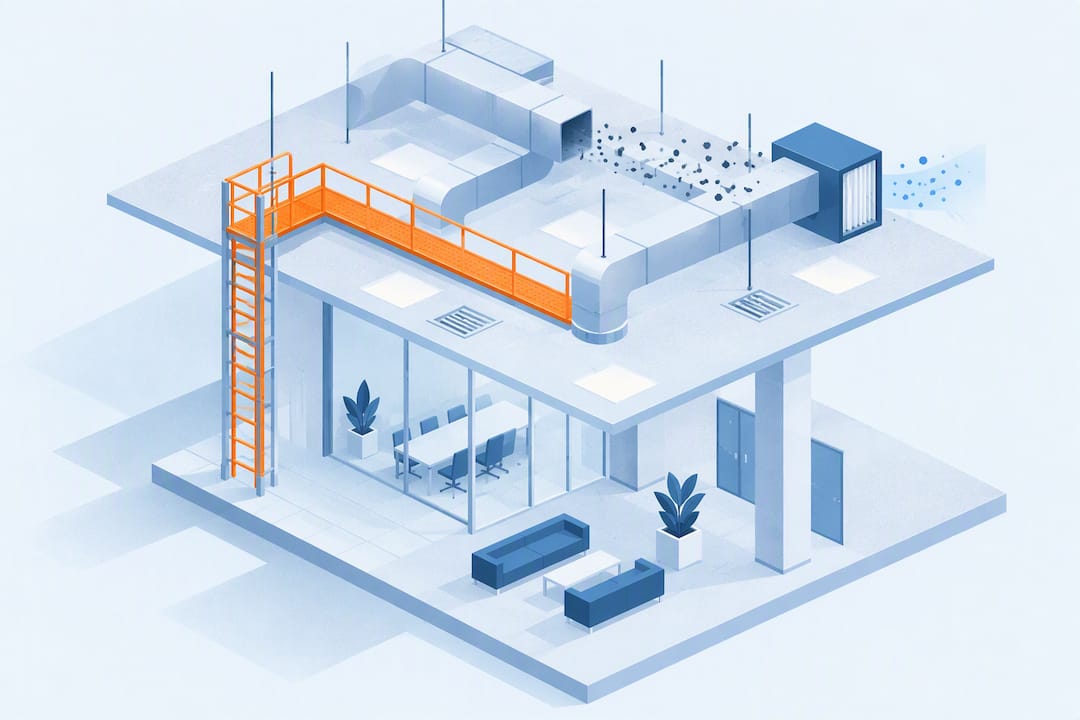
High dusting targets everything above standard reach, areas routine janitorial visits skip because they need extended tools or lift equipment. CCOHS identifies walls, ceilings, ledges, machinery, shelving, piping, conduits and light fixtures as places where dust collects and often needs specialized attention.
Typical elevated surfaces include:
- Ceilings, ceiling tiles and exposed structural beams or rafters
- Light fixtures, sprinkler heads and HVAC vents or diffusers
- High shelving, mezzanines and overhead piping or conduit runs
- Conveyor systems and elevated machinery housings in production spaces
Routine cleaning handles floors, desks and touchpoints at reach height. High dusting is a separate scope that reaches the overlooked zones between those surfaces and the ceiling. Warehouses, manufacturing plants, offices with open ceiling designs, food service kitchens and buildings fresh out of renovation all tend to need it on a recurring basis, since construction debris and settled dust accumulate fastest in exposed structural spaces. For offices specifically, the same logic that applies to commonly missed high-touch surfaces extends upward: what hands never touch, mops never reach either.
Why high dusting matters beyond appearance
Settled dust is not just a cosmetic issue. Health Canada’s indoor air quality guidance links proactive housekeeping, including HEPA-filtered vacuuming, to reduced dust exposure, lower fire hazard and better equipment performance, and recommends coordinating preventive HVAC maintenance with appropriate filtration as part of a broader air quality strategy.

Health Canada recommends HEPA-filtered vacuuming as part of indoor air quality management, tying regular, targeted dust removal directly to occupant exposure and equipment upkeep.
In industrial settings, the stakes climb further. Fine particulate that looks harmless on an office ceiling can behave very differently in a facility handling grain, flour or wood dust, where accumulation raises combustible-dust hazards. Beyond safety, dust buildup on HVAC components and overhead equipment shortens service life and drives more frequent maintenance calls. Tenants and inspectors notice overhead grime quickly, and it shapes how a facility is perceived long before anyone checks the floors.
Safety, compliance and access planning for elevated cleaning
Elevated work carries fall risk, and the access plan matters as much as the cleaning method. Under federal workplace rules, fall-protection planning is required before work where there is a risk of falling from a structure at 3 metres or more, and ladders must be assessed and properly secured before use; provincial requirements can set their own thresholds, so confirm the rule that applies to your jurisdiction.
Before any contractor starts work overhead, confirm the access plan covers the following:
- A documented hazard assessment covering height, structural obstacles and occupancy conditions.
- Selection of appropriate access equipment: secured ladders only where genuinely safe, otherwise a mobile elevating work platform or scaffold.
- Inspection of all access equipment immediately before use, with results recorded.
- Exclusion zones, warning signage and PPE appropriate to the task and environment.
- A firm rule against compressed-air blowdown, which scatters dust rather than removing it.
Pro Tip: Ask any bidding contractor to show you their hazard-assessment template before you sign; a vague answer here usually predicts a vague job report later.
Tools and methods that control dust properly
The tools a crew brings say more about quality than the price on the quote. Industrial HEPA-filter vacuum systems are the backbone of professional high dusting, paired with contact vacuuming attachments, extension dusting tools and brushes used only alongside vacuum collection rather than on their own. Damp wiping finishes the job on surfaces that tolerate it.
A few practices separate a controlled job from a messy one:
- HEPA-filter vacuums capture a high proportion of fine particulate instead of redistributing it into the air
- Extension poles and specialized attachments reach ceilings and beams without unnecessary ladder climbs
- Damp wiping lifts residue from fixtures and ledges that dry brushing would just scatter
- Brushing is always paired with simultaneous vacuum collection, never left to settle elsewhere
Methods to avoid in nearly every commercial setting include compressed-air blowdown and dry sweeping. CCOHS guidance on combustible dust recommends vacuums or wet methods instead of blowdown, since forcing air through settled dust can raise explosive concentrations and simply relocates the problem rather than solving it. Coordination with HVAC timing matters too: a competent crew isolates return-air openings or schedules the work during low-occupancy periods so disturbed particulate does not get pulled straight into the ductwork and redistributed building-wide. Filtration rating, whether MERV-rated media or true HEPA, is worth confirming for both the vacuum equipment and the building’s own HVAC filters.
A practical high-dusting job checklist
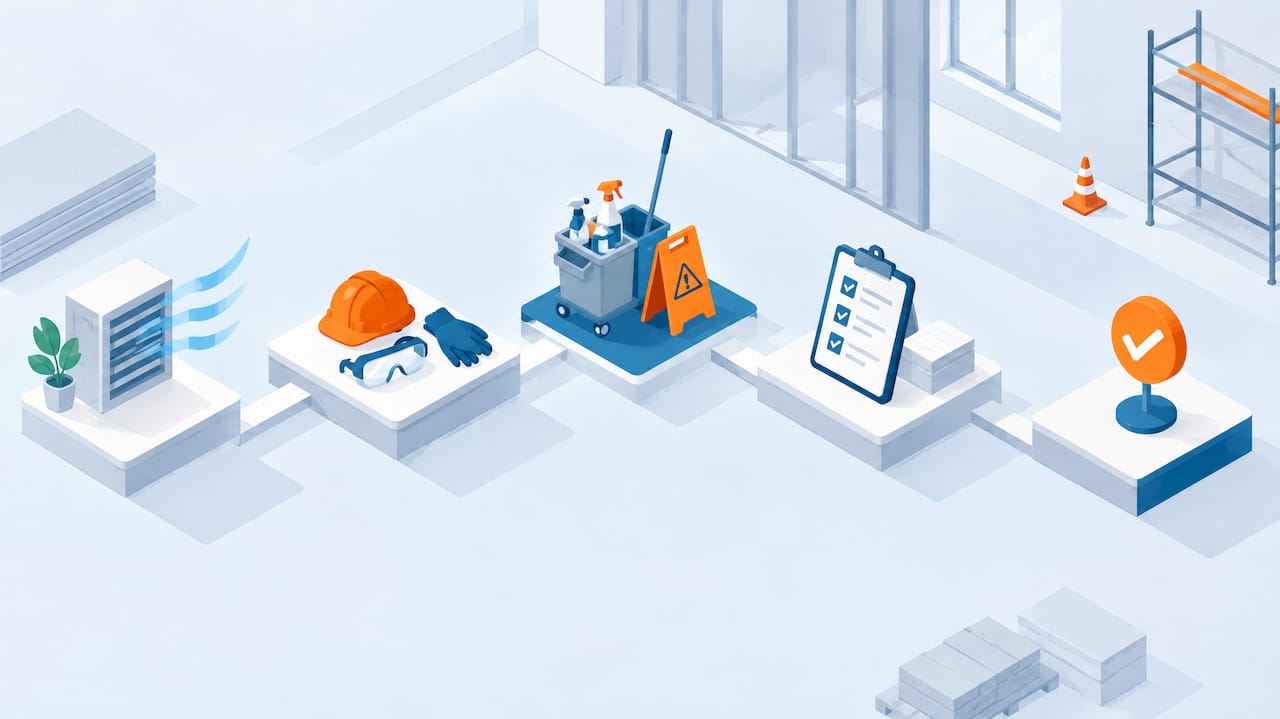
A well-scoped high-dusting job follows a clear sequence from walkthrough to final report, and asking for each stage in writing gives you something to hold a contractor accountable to.
- Pre-job: site walk to identify hazards, obstacles and fragile fixtures; client sign-off on scope; access plan confirmed; HVAC isolation arranged if the space requires it.
- During the job: method and equipment match the surfaces being cleaned; PPE worn consistently; exclusion zones maintained; spot checks confirm dust is being collected, not scattered.
- Post-job: completion inspection walk-through, photographic evidence of before and after conditions, a written report, and a recommended frequency for the next visit.
This structure also works well after renovation projects, where post-construction cleaning scopes frequently need an added high-dusting pass to catch drywall dust and debris that settles on overhead structures during the build.
What a trustworthy contractor’s proposal and report look like
A proposal worth signing spells out the hazard assessment process, the access-equipment checklist that will be used on site, the HEPA vacuum specification being brought in, and proof of current insurance coverage. These documents are not formalities; they are what protects your facility if something goes wrong mid-job.
Our own project reports follow this same pattern: a documented hazard assessment before work starts, an access-equipment inspection logged on-site, completion inspection notes, and use of HEPA-filter vacuums and controlled dust-collection methods throughout, with fall-protection planning built in whenever work reaches or exceeds 3 metres.
Deliverables worth asking for include:
- A written hazard assessment and access-equipment inspection record
- Before-and-after photographs documenting the condition of key surfaces
- A completion report with a recommended frequency for the next service
Deciding between a contractor and in-house maintenance
Height, access risk and combustible-dust potential should decide this, not budget alone. Anything requiring a lift, scaffold or work at or above 3 metres, or any facility handling combustible materials, belongs with a documented contractor. In-house staff can reasonably handle light dusting at reach height with extension tools between professional visits, provided they have proper PPE and never use ladders beyond safe working height. Folding a scheduled high-dusting visit into your regular maintenance calendar, rather than waiting for visible buildup, keeps both air quality and risk under control.
— Jack
Request a high-dusting quote for your Winnipeg facility
High dusting is one of the services we provide across Winnipeg alongside office cleaning, post-construction cleaning, gypcrete cleaning, industrial cleaning, floor care, commercial kitchen cleaning, kitchen exhaust cleaning and commercial carpet cleaning, all delivered through cleaning plans built around your facility rather than a generic checklist.
When you request a quote, ask us directly for the documented hazard assessment, the access method planned for your ceiling height, the HEPA vacuum specifications our crew will use, proof of insurance, and a completion report with photographic evidence. We back our work with ongoing quality control so you get the same documented standard on every visit. Get in touch for a site assessment and a quote scoped to your building.
FAQ
What do professional cleaners use for dusting?
Professional high-dusting crews rely on industrial HEPA-filter vacuum systems, contact vacuuming attachments and extension dusting tools, finishing with damp wiping where surfaces allow it. Brushing is only used alongside simultaneous vacuum collection so loosened dust never gets a chance to resettle elsewhere.
What is the best way to clean a lot of dust?
For heavy accumulation on elevated surfaces, a HEPA-filter vacuum paired with the right access equipment, a secured ladder, mobile platform or scaffold, removes dust without scattering it into the air. CCOHS housekeeping guidance points to vacuuming and controlled wiping over dry sweeping for exactly this reason.
What type of vacuum is best for high dusting?
An industrial vacuum fitted with a true HEPA filter is the standard for high dusting, since it captures fine particulate rather than recirculating it through the exhaust. Models with extension hoses and specialized ceiling or beam attachments make reaching elevated surfaces safer and more thorough.
What is grandma’s simple trick to eliminate dust?
Household tricks like microfibre cloths or damp wiping work fine for reachable surfaces, but they are not a substitute for HEPA vacuum extraction on ceilings, beams or ductwork. In a commercial setting, settled dust at height is a documented IAQ and, in some facilities, a combustible-dust concern, which calls for proper equipment rather than a household shortcut.
Sources
These sources informed the safety and method guidance above:
- Guidance on improving indoor air quality in office buildings — Health Canada
- Workplace housekeeping — CCOHS
Recommended
- Industrial Cleaning for Winnipeg Facilities
- High-Touch Surface Cleaning in Offices
- Commercial Carpet Cleaning: Hidden Health Hazards
- Post-Construction Cleaning Tips for Winnipeg Properties
Learn more about Eshine’s high dusting cleaning in Winnipeg.